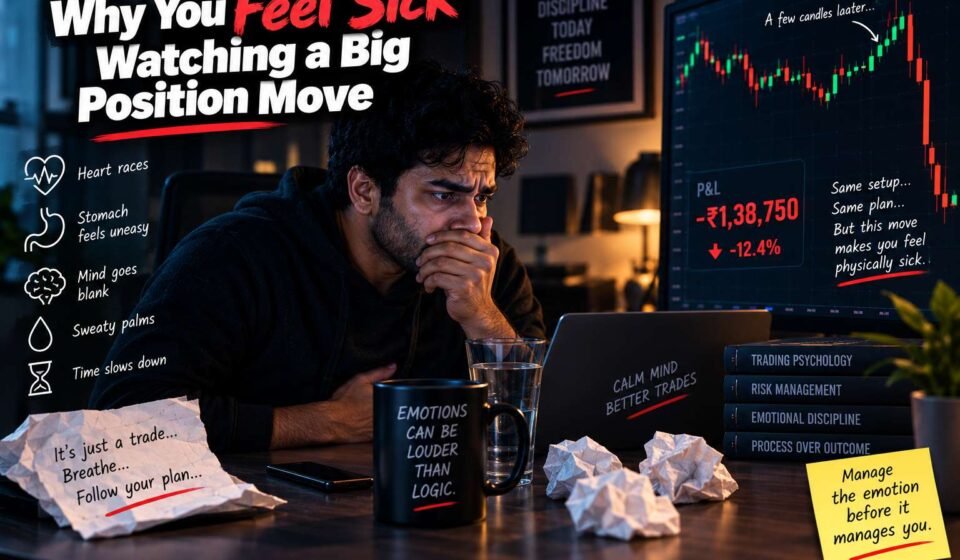

Two lots of Bank Nifty, three times your usual size, down 180 points and dropping. Your heart is going faster than it should for someone sitting still in a chair. Your mouth has gone dry. There is a tight band across your chest that has nothing to do with your lungs. You are not scared of anything that is actually going to hurt you. Your body does not know that.
What is actually happening in your body
The physical symptoms during a big live position, racing heart, tight chest, dry mouth, a knot in the stomach, sweaty palms, are the standard human stress response, the same one that activates during a near-accident on the road or a genuine physical threat.
Your nervous system does not distinguish well between a real physical danger and a large financial risk it perceives as threatening. Both trigger the same sequence: the adrenal glands release adrenaline and cortisol, your heart rate and blood pressure rise, blood gets redirected away from digestion and toward large muscles, and your breathing shifts to shorter, higher breaths. This is not a metaphor for stress. It is the literal biological system built for physical survival, activated by a number on a screen.
Why trading triggers this so effectively
A few specific features of live trading make it unusually good at activating this response, compared to most other modern situations.
- The threat is real, not imagined. Unlike many anxieties, the money on the line in a large position is genuinely at risk. Your body is not overreacting to nothing. It is reacting to something real, at a volume calibrated for a bigger physical danger.
- You cannot fight or flee. The stress response prepares your body to run or to physically defend itself. Neither option exists in front of a screen. The energy has nowhere to go, which is part of why it is felt so intensely in the body rather than released through action.
- The outcome is uncertain and out of your control once the trade is live. Uncertainty itself is a strong trigger for this response, independent of whether the eventual outcome is good or bad. Not knowing is often more physically activating than knowing something bad.
- It happens repeatedly, sometimes daily. A near-accident on the road is rare. A large live position can happen several times a week, which means some traders are running this stress sequence far more often than their body was built to handle comfortably.
Why oversized positions make this dramatically worse
The intensity of this response scales closely with how much is actually at risk relative to what feels normal to you. A position that is double or triple your usual size does not just double the financial risk. It often produces a disproportionately larger physical response, because the size itself signals to your nervous system that something unusual and important is happening.
This creates a specific trap. The physical discomfort of an oversized position can push a trader toward exiting early, purely to make the sensation stop, regardless of what the chart is actually showing. The exit decision ends up driven by the body’s urgency to end the physical discomfort, not by any read of the market.
“I just need this to be over, I can’t sit here feeling like this.”
That thought is not weakness. It is an accurate description of what an activated stress response feels like from the inside, and it explains a huge share of early, panicked exits on positions that were, at that exact moment, still within a normal range.
The difference between useful signal and pure overload
Some physical activation is not a problem to eliminate. A mild version of this response can sharpen focus and attention, which is part of why some traders perform well under moderate pressure. The issue is not that the body responds. The issue is when the response is intense enough to start driving decisions on its own, faster than your plan can be consulted.
A rough way to tell the difference:
- Useful activation: You notice a racing heart, you can still read the chart clearly, and you can still recall your stop and target without difficulty.
- Overload: The physical sensation is loud enough that reading the chart or recalling your plan takes real effort, and your main goal shifts from managing the trade to making the feeling stop.
What this looks like across a normal week
Monday, your position is standard size, the trade goes against you slightly, and you barely notice any physical sensation at all. Wednesday, after two losing days in a row, you take a trade at the same size, and your chest feels tight before price has even moved. Friday, you double your usual size on a setup you are confident about, and within minutes your hands are damp and your breathing has gone shallow, even though the trade is only marginally in the red.
Same trader, same account, three very different physical experiences, because the trigger is not the position size alone. It is the size combined with your current stress reserves, which shrink after losing streaks, poor sleep, or outside pressure, and shrink further the moment you push size above what has recently felt normal to you.
What actually helps in the moment
- Slow, extended exhales, not deep breaths in. A longer exhale than inhale, for example a count of 4 in and 6 out, directly signals the nervous system to reduce activation. This is a physiological lever, not a relaxation technique that requires belief in it to work.
- Reduce position size until the physical response is manageable, not eliminated. If a certain size reliably pushes you into overload, that size is too large for your current capacity, regardless of what your account can technically afford.
- Stand up and change your physical posture. The stress response prepares the body for movement. A short walk, even thirty seconds, gives that energy somewhere to go and often reduces the intensity noticeably.
- Use pre-placed stop and target orders on your larger positions specifically. Removing the need for a live decision matters most exactly on the trades where your body is least able to support clear thinking.
- Name the sensation out loud or in your head: “this is my stress response, not new information about the trade.” This does not remove the feeling, but it stops the feeling from being mistaken for a market signal.
- Build a simple pre-trade check on sleep, recent losses, and outside stress. Knowing you are starting the day already depleted lets you size down before the physical response has a chance to take over a live decision.
- Keep a plain glass of water at your desk and drink from it during a stressful trade. The physical act of swallowing slowly is a small, reliable signal to the nervous system that the situation is being handled, and it gives your hands something deliberate to do besides reaching for the exit button.
This is the Aware step in the ACE framework applied to the body rather than the chart. Recognising a racing heart as physiology, not prophecy, is what keeps the next decision anchored to your plan instead of to your nervous system.
Frequently asked questions
Is it normal to feel physically sick during a big trade?
Yes, particularly on positions larger than your usual size or during periods of high uncertainty. It is the standard human stress response activated by real financial risk, not a sign of unsuitability for trading.
Why do I feel this more on some trades than others of similar size?
Sleep, existing stress from outside the market, recent losses, and how central the outcome feels to your broader goals can all amplify the same objective position size into a much stronger physical response on a given day.
Can this physical response actually hurt my trading decisions?
Yes, particularly when it reaches overload rather than mild activation. Strong physical stress narrows attention and pushes toward the fastest available action, which is often an early exit or a frozen non-decision, rather than the action your plan calls for.
Does this feeling go away with more experience?
It often reduces at a given position size as that size becomes more familiar, but it typically resurfaces at whatever size currently feels large relative to your comfort. Reducing size and using pre-placed orders tends to help more reliably than time alone.
Should I avoid trades that make me feel this way?
Not necessarily avoid the trade, but consider whether the position size is appropriate. Sizing down the same setup often reduces the physical response enough that you can execute your plan clearly, without needing to skip a genuinely good setup.
The real point
Your racing heart is not telling you the trade is wrong. It is telling you that your body thinks something dangerous is happening, using a system built millions of years before anyone invented a P&L screen. The market does not reward better predictions. It rewards better decisions, and better decisions are easier to make once you stop mistaking your body’s alarm for the market’s opinion.
Dil tez chal raha hai iska matlab yeh nahi ki trade galat hai.
Related reading:
- What Happens in Your Brain While a Trade Is Open
- Overtrading: The Habit That Quietly Empties Accounts
- Adding to a Winning Position: When It Is a Plan and When It Is Greed
Want to break this loop properly? I run a free live session twice a week for traders with two or more years of experience who know the setups but still cannot execute under pressure. Register for the next free session here.
I am Samir Dash, founder of Mindful Trading Hub. I work with experienced traders on live market decision-making. More about my story here.