
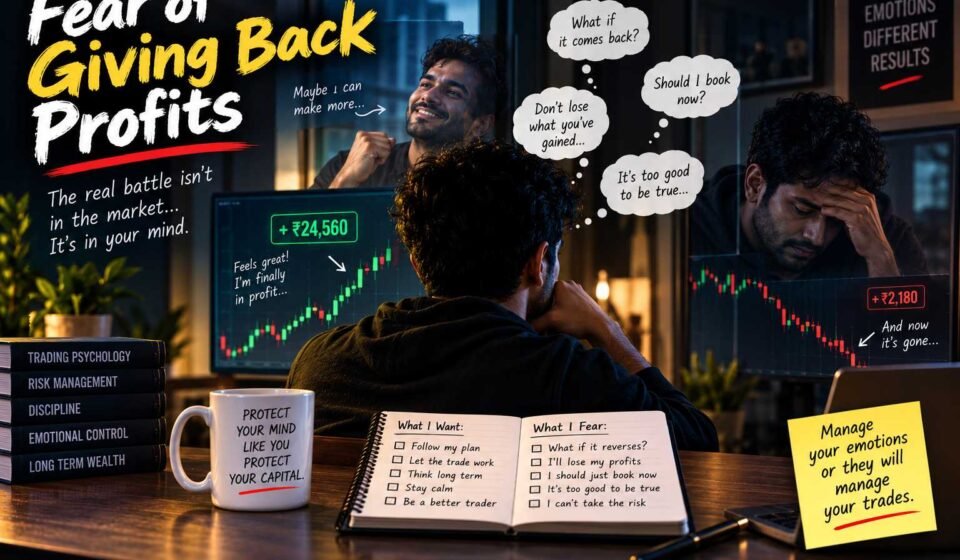

Your trade is up ₹9,000. Your target is still 40 points away. Price pulls back three ticks, nothing unusual, completely normal for the move so far. Your hand is already on the exit button. Not because your plan says to exit. Because the thought “I could lose this ₹9,000” just showed up, and it feels more real than anything on the chart.
This is one of the most common reasons traders cut winning trades short, and it has almost nothing to do with the actual chart in front of them.
What this fear actually is
Fear of giving back profits is the urge to close a winning position early, not because your exit plan says to, but because the unrealised gain now feels like something you could lose, and losing it feels worse than never having had it.
It shows up specifically on trades that are already working. A flat or losing trade does not trigger this fear, because there is nothing yet to give back. The fear only activates once a gain exists on screen.
What it looks like while the trade is open
- Every small pullback, even a normal one within the trade’s usual range, feels like the start of a reversal.
- You start mentally converting the unrealised profit into something you have already spent, like “that’s the school fees covered,” which makes losing it feel like losing money you already own.
- You exit at a level well below your target, then watch price continue toward where your target was.
- Afterward, you feel relief first, then irritation once you see the price kept moving without you.
- You tell yourself “profit booked is profit earned,” which is true in general but is being used here to justify breaking your own plan.
Why an unrealised gain feels like it is already yours
The mechanism is the endowment effect, the same one that shows up in greed and in adding to winners, but working in the opposite direction here. Once a profit is visible, your brain files it as belonging to you, even though nothing is booked and the number can still move either way.
Because losses hurt roughly twice as much as equivalent gains feel good, the idea of that number shrinking, even back to a smaller but still positive number, gets processed by your brain in the same category as an outright loss. You are not actually afraid of ending the trade with less money than you have now. You are afraid of the feeling of watching a number go down, regardless of whether it is still positive.
This is why traders will happily exit a trade up ₹6,000 that could have been up ₹15,000, and still call it a good trade, while feeling real anxiety about the ₹9,000 in the few minutes before that exit. The fear is about the direction of movement, not the actual outcome.
“I’m just going to lock this in before it turns, better safe than sorry.”
That sentence sounds sensible. It is actually the sound of a plan being abandoned because a number that already exists in your head is more vivid than the plan written on paper.
Why this is different from a genuine invalidation signal
Not every early exit is fear. Sometimes price action genuinely tells you the trade thesis has weakened, and closing early is the correct call. The difference is where the signal comes from.
- A genuine signal comes from the chart. A key level breaking, volume drying up at a level that should have volume, a clear structural change.
- A fear-driven exit comes from the P&L number. The chart has not changed in any way you could describe to someone else. The only thing that changed is how much you currently have to lose.
The test is simple. Could you point to a specific chart reason for exiting right now, one that existed independently of your current profit? If the only honest answer is “I just didn’t want to lose what I had,” that is fear, not analysis.
What this fear costs over time
Say your system produces an average winning trade of 55 points when held to plan, but the fear of giving back profits regularly triggers an exit around 25 points instead. That gap, roughly 30 points per winning trade, compounds across every winner you have. Your win rate does not change. Your actual reward per win quietly gets cut close to in half.
A strategy that looks profitable on paper, based on its backtested reward to risk ratio, can underperform badly in live trading purely because the trader never actually captures the reward side of that ratio. The edge exists. It just never reaches the account.
A closer look at what the anxious mind is actually doing
It helps to notice that this fear rarely calculates anything. In the moment, you are not weighing the odds of continuation against the odds of reversal. You are running a single, simple comparison in your head between the number you see right now and zero, or between the number you see right now and the smaller number you would have if it dropped a little.
That comparison ignores everything your original plan already accounted for, including your stop, your target, and the statistical edge of your setup over many trades. It replaces all of that with a single, urgent question: can I make this uncertainty go away right now. The answer trading gives you, exiting, always feels like yes in the moment, which is exactly why the urge is so persistent even for traders who know better.
How to manage this without becoming reckless
- Use a structured partial exit instead of an all-or-nothing decision. Booking a third of the position at a set profit level satisfies the urge to protect gains without abandoning the rest of the plan.
- Separate “protect the profit” from “exit the whole trade.” A trailing stop protects gains while still allowing the trade room to reach its target. This gives the anxious part of you a real answer instead of forcing a full exit.
- Write your target and hold rule before entry, and treat any urge to exit early as a signal to check that written rule, not to act on the feeling.
- Ask the chart-reason test in the moment. If you cannot name a specific price-based reason, the urge is coming from the P&L number, not the market.
- Track how often early exits underperformed your target over a month of trades. Seeing the actual gap in points, not just the feeling of relief, is often what finally shifts the habit.
- Remind yourself that a plan followed consistently across many trades outperforms a plan abandoned selectively. One early exit rarely matters much on its own. The habit, repeated across every winning trade you take, is what quietly caps your results.
This is the Control step of the ACE framework. The trailing stop and the partial exit rule are decisions made in advance so the anxious version of you mid-trade has a structure to follow instead of a raw impulse to act on.
Frequently asked questions
Is it always wrong to exit a trade early?
No. Exiting because of a genuine chart-based invalidation is a valid decision. It becomes a problem only when the real reason is the fear of losing an existing paper profit, with nothing on the chart to support the exit.
Why does a small pullback feel so threatening once I’m in profit?
Because your brain has already started treating the unrealised gain as yours, through the endowment effect. Any pullback, even a normal one, gets processed as the start of losing something you already own, rather than as ordinary price movement.
How do I know if I should trust the urge to exit early?
Check whether you can name a specific price-based reason independent of your current profit. If the only reason is protecting the number on screen, the urge is fear, not analysis.
Does a trailing stop fully solve this problem?
It solves most of it, because it gives you a structured way to protect gains without a full manual exit. It does not remove the underlying fear, but it removes the need to act on it impulsively.
Why do I feel relief after exiting early, even when it was the wrong call?
Relief comes from ending the discomfort of an open, uncertain position, regardless of whether the exit was optimal. The relief is real, but it is not evidence that the decision was correct.
The real point
The fear of giving back profits is not really about the money. It is about not wanting to watch a number go down, even when it is still a good number. The market does not reward better predictions. It rewards better decisions, and the decision that protects your gains without starving your plan was made before the fear ever showed up.
Profit tab tak aapka nahi jab tak book na ho, lekin darr ko plan todne ka haq bhi nahi.
Related reading:
- What Happens in Your Brain While a Trade Is Open
- Overtrading: The Habit That Quietly Empties Accounts
- Adding to a Winning Position: When It Is a Plan and When It Is Greed
Want to break this loop properly? I run a free live session twice a week for traders with two or more years of experience who know the setups but still cannot execute under pressure. Register for the next free session here.
I am Samir Dash, founder of Mindful Trading Hub. I work with experienced traders on live market decision-making. More about my story here.