

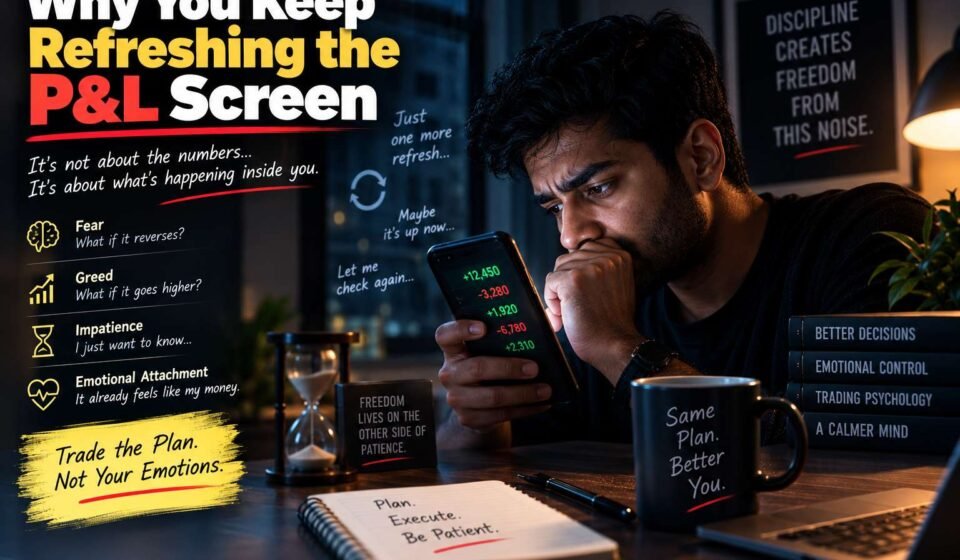

You placed the trade four minutes ago. You have already opened the P&L screen nine times. Nothing has changed about your plan, your stop, or your target. The number just moved from minus 200 to minus 150 to minus 220 to minus 180, and you watched every single one of those moves happen, live, on your phone, while sitting in a meeting you are supposed to be paying attention to.
This is not curiosity. It is one of the most common and least talked about habits in live trading, and it has a specific mechanism behind it that has nothing to do with weak discipline.
What this habit actually is
Refreshing the P&L screen repeatedly during an open trade means checking your unrealised profit or loss far more often than any new information could justify, often every few seconds or minutes, well beyond what is needed to manage the position.
A trader checking price at their planned decision points, say every fifteen minutes near a target, is managing a trade. A trader checking every twenty seconds regardless of any plan is doing something else entirely.
Why this number pulls at you so hard
It is a variable reward, exactly like a slot machine
Each time you refresh, the number might be better, might be worse, or might be unchanged. You cannot predict which. This unpredictability is the same mechanism that makes slot machines and social media feeds hard to put down. A reward that arrives on a random, unpredictable schedule pulls at attention more strongly than a reward that arrives predictably, because the brain keeps checking in case this refresh is the good one.
An open trade is an unfinished loop
As long as the trade is open, the outcome is not settled. Unfinished tasks generate a pull on attention that finished ones do not, the same mental mechanism that makes you think about an unsent message more than a sent one. Checking the screen feels, in the moment, like you are doing something about the open loop, even though looking at a number changes nothing about the trade itself.
It feels like control, but it produces none
Watching the number does not change the number. Yet each check delivers a small hit of information that your brain treats as progress, similar to how refreshing an email inbox feels productive even when nothing new usually arrives. You are not managing the trade by watching it. You are managing your own anxiety about the trade, and using the P&L screen to do it.
“Let me just check once more before I put the phone down.”
That thought repeats every time, and it is never actually the last check.
What this habit costs you, beyond the obvious
- It amplifies every small move. A trade that would move from plus 100 to minus 50 and back to plus 200 over an hour, if watched only twice, feels calm. Watched forty times, the same trade feels like a rollercoaster, because you experienced every intermediate swing as its own event.
- It increases the odds of an impulsive exit. The more often you see a red number, the more chances you give yourself to panic-close a trade that was actually within its normal range.
- It pulls you out of everything else in your life. Meetings, conversations, family time, all get fragmented by a habit that produces no trading benefit in return.
- It trains your brain to associate trading with constant vigilance rather than a plan executed and then left alone, which makes every future trade feel more effortful than it needs to.
Why “just don’t check” does not work
Telling yourself to stop checking is fighting a pull that is built the same way as any variable reward habit. It rarely works through willpower alone, because willpower is a limited resource and the pull is not really about the P&L number. It is about needing somewhere to put the anxiety of an open, uncertain outcome. Removing the checking without giving that anxiety anywhere else to go usually just delays the next binge of checking.
A day in the life of the habit, without you noticing
You place a trade at 10:05. By 10:20, without deliberately deciding to, you have opened the app fourteen times. Between checks, you have also opened your messaging app and a news app, almost as a break from the P&L screen, only to come back to it a minute later. None of the fourteen checks changed your stop, your target, or any part of your plan. All fourteen changed your mood for the next few minutes, up or down, depending on the number.
By the time the trade closes at 11:00, you have checked it roughly forty times across the hour. If you had set two alerts, one at your target and one at your stop, and put the phone face down in between, you would have received the exact same trading outcome with a fraction of the mental effort and none of the mid-trade mood swings that had nothing to do with your actual plan.
What actually reduces it
- Set alerts at your actual decision points instead of watching continuously. An alert at your target, your stop, and one midpoint level gives you exactly the information you need, exactly when you need it, and nothing in between.
- Use bracket or GTT orders so the trade does not need supervision. If the exits are already placed as orders, checking the screen produces zero new decisions you could make anyway, which weakens the pull over time.
- Put the phone or terminal physically away for a set block. Not “try not to check.” Put the device in another room for twenty minutes at a time. Removing the option is more reliable than resisting the option.
- Name the urge out loud when it hits. Saying “I want to check because I’m anxious about this trade, not because there’s a decision to make” separates the urge from the action and often reduces its pull within a few seconds.
- Schedule specific check-in times if a full block is not realistic. Three planned checks an hour, at set times, is dramatically calmer than forty random ones, even though the total information gained is similar.
- Turn off non-essential push notifications from your trading app. Every buzz is an invitation to check, and each one restarts the pull, even on trades you had otherwise stopped thinking about.
- Replace the checking impulse with a different small action, like noting the time and current price in a notebook once at each scheduled check, rather than glancing at a live number that updates every second. A number that only updates when you write it down carries far less pull than one that moves in real time.
This is Awareness in the ACE framework applied to a habit that most traders never name as a habit at all. Once you see refreshing as anxiety management rather than trade management, the fix stops being about the screen and starts being about the alert settings and the orders that make watching unnecessary.
Frequently asked questions
Is checking my P&L frequently actually harmful to my trading?
It rarely changes the outcome of a single trade directly, but it increases the odds of an impulsive exit at a normal price swing, and it trains a pattern of anxiety around every future open position. The harm builds up across many trades rather than showing up in one.
How often should I actually check an open trade?
Only as often as your plan requires a decision. If your exits are placed as orders, checking at your planned review points, such as every 15 to 30 minutes or at key levels, is usually enough. Continuous checking rarely adds decision-relevant information.
Why does refreshing the P&L screen feel almost addictive?
Because it delivers an unpredictable outcome each time you check, similar to how a slot machine or a social media feed works. Unpredictable rewards pull at attention more strongly than predictable ones, which is why the habit feels compulsive rather than optional.
Does watching my trade closely help me react faster to problems?
If your stop and target are already placed as orders, there is usually nothing left for you to react to that the orders will not handle automatically. Close watching adds anxiety more often than it adds useful reaction speed.
What should I do instead of checking constantly?
Set price alerts at your actual decision points, place bracket or GTT orders so exits do not need live supervision, and physically separate yourself from the screen for planned blocks of time.
The real point
The number on that screen is not information you can act on most of the time. It is a mirror reflecting your own anxiety back at you, over and over, every few seconds. The market does not reward better predictions. It rewards better decisions, and most of those decisions were already made the moment you placed your stop and target.
Screen dekhne se trade nahi badalta, sirf mann bechain hota hai.
Related reading:
- Risk Management Rules That Actually Get Followed
- When to Exit a Trade: The Decision Framework Most Traders Skip
- Greed in Trading: What It Actually Feels Like in a Live Trade
Want to break this loop properly? I run a free live session twice a week for traders with two or more years of experience who know the setups but still cannot execute under pressure. Register for the next free session here.
I am Samir Dash, founder of Mindful Trading Hub. I work with experienced traders on live market decision-making. More about my story here.