
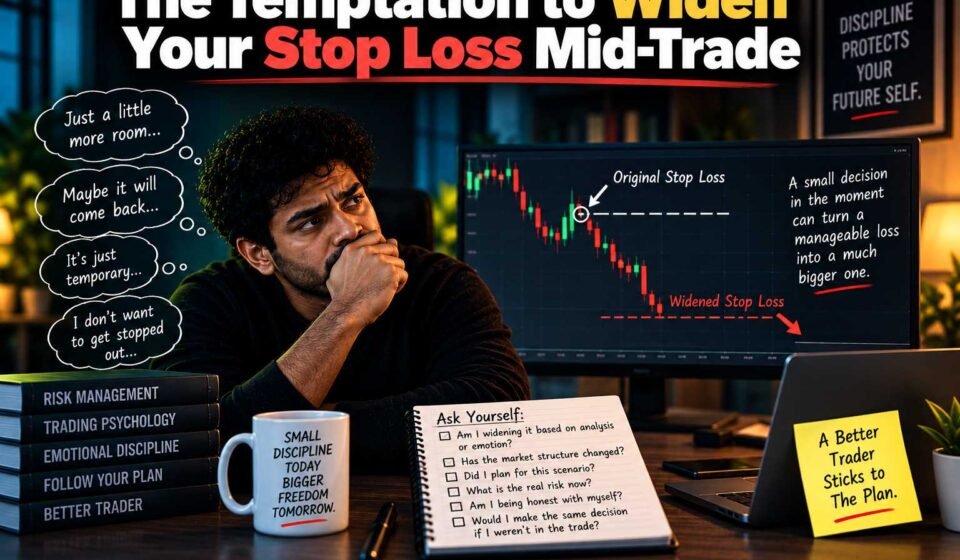

Price is 8 points from your stop loss. You are short Bank Nifty, the candle is red, and it looks like it wants to bounce right at your level. Your hand moves to the stop order. Not to close it. To move it, just 20 points further away, “to give it room.”
This one action, done quietly, without telling anyone, is responsible for more account damage than almost any other single habit in trading. Not the loss itself. The moved stop.
What widening a stop loss actually is
Widening a stop loss mid-trade means moving your stop order further from current price, after the trade is already open, so the trade can survive a move that would have closed it at the original level.
It is different from a planned trailing stop, which only moves in the direction that reduces risk. Widening moves the stop in the direction that increases risk, almost always while the trade is going against you.
What it looks like on screen
The sequence is almost always the same:
- Price approaches your stop level.
- You open the order modification screen, telling yourself you are “just checking.”
- You find a reason on the chart. A support level slightly below your stop. A round number. A previous swing low.
- You move the stop to just past that new level.
- Price often hits the new stop too, sometimes within minutes.
The chart reason is real. That is what makes it dangerous. There is almost always some level nearby that can justify moving a stop. The market has support and resistance everywhere if you are looking for a reason to find one.
Why this urge is so strong right at the stop level
The stop loss is not just a price level. It is the exact point where an open loss becomes a closed one. As long as the trade is open, the loss exists only on a screen. The moment the stop triggers, it becomes a fact, something you have to accept and write down.
This is called loss aversion, and it runs at roughly double the strength of the pleasure from an equivalent gain. Losing ₹8,000 does not feel like the opposite of winning ₹8,000. It feels heavier and it lasts longer in your mind. So when price sits one tick from your stop, your brain is not weighing “small loss versus no loss.” It is trying to avoid a feeling that is running at double intensity, and moving the stop is the fastest way to make that feeling go away, even for ten minutes.
There is a second piece. As long as the position is open, you can still be right. The moment it closes at a loss, you were wrong, on the record. Widening the stop is not really a market decision. It is a way to postpone being wrong.
“It’s just testing the level, give it a bit more room and it’ll turn.”
That sentence shows up as analysis. It is actually the sound of a trader trying to avoid admitting the entry was wrong, for another twenty minutes.
Why the new stop rarely saves the trade
If a level was worth using, it would have been your stop from the start. You did not pick it before entry because your analysis told you the trade was invalid below that point. You are picking it now because price is near your original stop and you want an excuse.
In practice, three things tend to happen after a widened stop:
- Price hits the new stop too, and the loss is now bigger than it should have been.
- Price reverses just enough to trigger a second widening, because the pattern repeats itself once it has worked once.
- On the rare occasion it works, you learn the wrong lesson. You learn that widening stops saves trades, and you do it again next time with more size.
That third outcome is the most expensive one long term, because a single win teaches the habit and makes it feel skillful instead of risky.
The real cost, in numbers
Assume you risk ₹6,000 on a trade with a stop 40 points away on Bank Nifty. Price nears the stop and you widen it by 25 points, roughly doubling your rupee risk to around ₹12,000. If the trade then reverses to your new stop, you have converted a planned ₹6,000 loss into a ₹12,000 one.
Do that twice a month and you have added ₹1.44 lakh a year in losses that your own trading plan never called for. None of that shows up as a bad strategy. It shows up as one small click, repeated.
A story that plays out the same way almost every time
You are short Nifty from 24,500, stop at 24,540. Price grinds up to 24,532. You open the modify order screen. You notice a resistance zone at 24,560 on the higher timeframe chart, one you had not marked before entry. You move the stop to 24,575, telling yourself the trade needs “room to breathe” through that zone.
Twelve minutes later, price touches 24,573, two points shy of your new stop, then reverses hard and closes the day at 24,410, well below your original entry. Had you left the stop at 24,540, you would have taken a small, planned loss and been free to look for the next setup with a clear head. Instead you spent those twelve minutes anxious, watching a level that only existed because you needed an excuse, and you very nearly lost far more than your plan called for.
This is not a rare story. It is close to the median outcome when a stop gets widened under pressure, because the widened level is chosen by a mind looking for a reason to avoid a loss, not by a mind evaluating where the trade is genuinely still valid.
What actually stops it
The fix is not willpower in the moment. By the time price is near your stop, you are in the exact state that makes willpower unreliable. The fix has to be structural.
- Set the stop as a hard order at entry, not a mental level you plan to execute manually. A mental stop is just a suggestion to a stressed brain.
- Use a platform or broker setting that requires a second step to modify an open stop, if available, so it is never a single click.
- Write the stop level and the reason for it before entry, on paper or in a trade journal. If you cannot point to that written reason when you want to move the stop, you are not allowed to move it.
- Treat “give it more room” as a red flag phrase. The moment you catch yourself thinking it, that is the signal to leave the order alone, not the signal to act.
- Separate stop modification from stop cancellation. If you truly believe the trade thesis has changed, close the position and re-enter fresh with a new stop. Do not stretch the old one.
This is the Control step in the ACE framework in its purest form. The decision about your stop was already made by the calmer version of you, before the trade opened. The job during the trade is simply to not undo it.
Frequently asked questions
Is it ever okay to widen a stop loss?
Almost never while a trade is open and moving against you. The only defensible version is closing the trade entirely and re-entering as a fresh decision with a new stop based on new information, not stretching the existing one to avoid a loss.
What is the difference between widening a stop and trailing a stop?
A trailing stop only moves in the direction that locks in profit or reduces risk. Widening moves the stop in the direction that increases risk, almost always because price is approaching it. They look similar because both involve moving an order, but they move for opposite reasons.
Why do I always find a chart reason to justify moving my stop?
Because charts have support and resistance levels everywhere. If you are looking for a reason to move a stop, the market will almost always offer you one nearby. The presence of a reason does not mean the reason is why you are actually moving it.
How do I stop myself from touching the stop order?
Use a hard stop order placed at entry rather than a mental stop, write down the reason for the level before you enter, and treat any urge to modify it as a signal to step away from the screen rather than a signal to act.
Does widening a stop ever work out?
Occasionally, and that is what makes it dangerous. A single win teaches your brain that the behaviour is skillful. Judge it across many instances, not one, and the pattern is almost always a net cost.
The real point
Your stop loss is not a suggestion made by a hopeful version of you. It is a decision made by a calm version of you, sitting before the trade, thinking clearly about what would prove the idea wrong. The market does not reward better predictions. It rewards better decisions, and one of the best decisions available to you is simply leaving that order alone.
Stop loss ek waada hai jo aapne apne aap se kiya tha, tod mat dena.
Related reading:
- Risk Management Rules That Actually Get Followed
- When to Exit a Trade: The Decision Framework Most Traders Skip
- Greed in Trading: What It Actually Feels Like in a Live Trade
Want to break this loop properly? I run a free live session twice a week for traders with two or more years of experience who know the setups but still cannot execute under pressure. Register for the next free session here.
I am Samir Dash, founder of Mindful Trading Hub. I work with experienced traders on live market decision-making. More about my story here.