

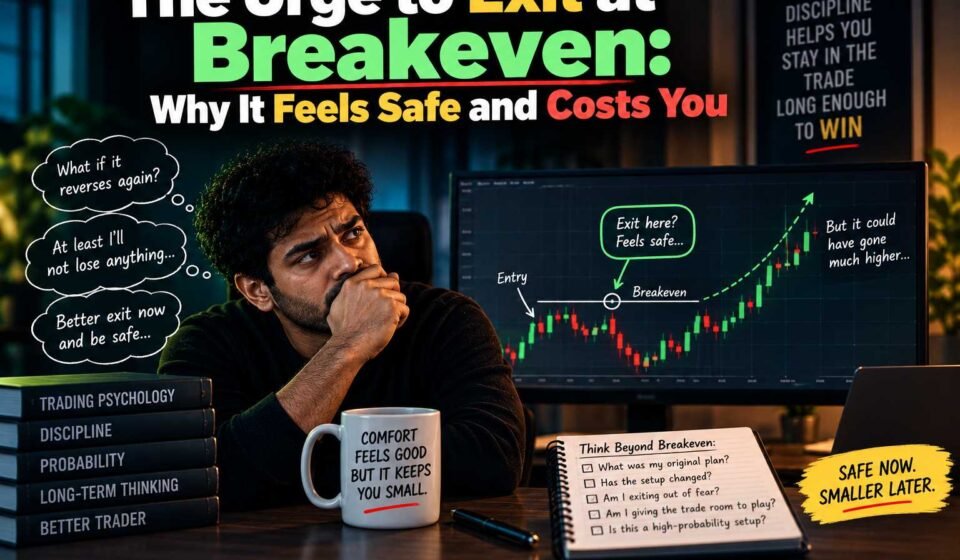

You entered at 24,850. The trade ran up to 24,950, 100 points in your favour. Then it turned and started coming back. 24,930. 24,910. 24,890. 24,870. As it approaches 24,850, your entry price, one thought takes over everything else: get out now, before this becomes a loss.
You close it at 24,852, two points of profit, technically a win, and feel a strange mix of relief and disappointment. The trade later goes on to hit your original target. This exact sequence, exiting right around breakeven on a trade that had real room to work, is one of the most common patterns in live trading, and it has a specific mechanism behind it.
Why your entry price becomes a magnet
Your entry price is not just a number on the chart. It is the line that separates “this trade made money” from “this trade lost money” in your own mental accounting. As price falls back toward that line from above, you are not just watching a normal pullback. You are watching the trade cross from one emotional category into another, in real time, in front of you.
This is why the pain of watching price approach your entry from above feels sharper than watching the same price level approached from below, on a trade that never went green in the first place. The trade “had” a profit, and now it is at risk of losing that categorical status, not just the rupee amount.
Why breakeven feels like the safe choice
Exiting at breakeven feels like the responsible, risk-managed decision. You are not losing money. You are not being greedy. On the surface, it looks like discipline.
But look closer at what is actually driving the decision. If your stop loss has not been hit, and your original setup reasoning has not been invalidated, there is no rule-based reason to exit at breakeven specifically. The trade has not failed. It has simply pulled back from its high, inside a range your stop was already designed to tolerate. Breakeven only feels significant because of what it represents to you, not because of anything happening on the chart.
“At least I won’t lose on this one. I can live with a scratch.”
That sentence is about protecting your ego and your win-rate tally, not about following your plan. A trade that hits your actual stop and a trade that scratches out at breakeven are treated very differently in your head, even when your account risk was set up to tolerate both outcomes equally.
The real cost, in trades you can count
The cost of this pattern is not one trade. It is a specific category of trade that repeats often: a genuinely good setup, that ran into real profit, that pulled back to entry, and that would have gone on to hit target if you had simply let your actual stop, not your entry price, make the decision.
Go back through your last twenty trades and count how many were closed at or very near breakeven after having been meaningfully in profit first. For most traders who have this pattern, it is not one or two trades. It is a recurring category, and each one represents the difference between a full winner and a scratch, multiplied by however many times it happens in a month.
Why moving your stop to breakeven is not the same as exiting there
There is an important distinction worth making clear. Moving your stop loss up to your entry price, once a trade has moved meaningfully in your favour, is a legitimate and common risk management technique. It protects you from a full loser turning what was a winning trade into a losing one.
The problem described in this post is different. It is exiting manually, in the moment, driven by watching price approach your entry, regardless of where your actual stop is. If your stop is at 24,800 and price is at 24,855, moving toward your entry of 24,850, a manual exit right now is not stop management. It is the breakeven magnet taking the decision away from your plan.
What this looks like on a chart, step by step
You buy Nifty futures at 24,850. Price runs to 24,950. You feel good, briefly. Price then turns and starts falling: 24,930, 24,910, 24,890. Your stop is still sitting at 24,800, untouched. But somewhere around 24,860, ten points above your entry, your hand is already on the mouse.
At 24,852, two points of open profit, you close it. Price is not near your stop. Nothing about your original setup has changed. The only thing that changed is a number on your screen crossed from “comfortably green” to “almost at my entry,” and that crossing alone was enough to trigger the exit.
How to tell which one is happening to you
- Legitimate breakeven stop: Decided in advance, as part of your plan, once a trade reaches a specific point of profit. The stop moves. You do not manually exit early.
- Breakeven exit urge: A live, in-the-moment decision to close the trade because price is approaching your entry, made outside of any rule you wrote down before the trade began.
If you find yourself closing a trade the instant price nears your entry, without checking whether your actual written stop has been hit, this is the urge, not the plan.
What actually fixes this
- Decide your breakeven-stop rule in advance, including the exact point of profit at which your stop moves to entry, and let that be the only mechanism that triggers a breakeven exit.
- Once the rule is set, treat the trade as either “stop not hit, hold” or “stop hit, closed automatically,” with nothing in between that depends on how price looks approaching your entry.
- Use an actual stop order where possible, rather than a mental stop, so the decision is executed by your broker’s system, not by your hand on the mouse while watching price approach a meaningful line.
- Separate your win-rate tracking from your profitability tracking. A trader chasing a high win rate is far more likely to manually rescue a trade at breakeven. A trader tracking overall rupee outcome has less reason to protect that specific number.
Why win-rate obsession makes this worse
Many traders track win rate as their main measure of how they are doing, often more closely than they track actual rupee profit and loss. This creates a strong, quiet incentive to protect that number, even at the cost of overall results.
A trade closed at two points of profit counts exactly the same as a trade closed at your full 200-point target, when you are only looking at wins versus losses. This is precisely why the breakeven urge is so persistent. It is not irrational from the narrow view of protecting your win-rate percentage. It only looks irrational once you widen the view to actual rupees earned across a month, which is the number that pays your bills, not the percentage.
Frequently asked questions
Why do I always want to close a trade the moment it comes back to my entry price?
Your entry price marks the boundary between a winning trade and a losing one in your own mental accounting. Watching price approach it feels like watching the trade’s status change, which triggers a strong urge to lock in a scratch before it crosses into loss territory.
Is moving my stop to breakeven a bad habit?
No, moving a stop to breakeven once a trade has moved meaningfully in your favour is a sound risk management technique, as long as it is decided in advance as part of your plan, not triggered by watching price approach your entry live.
How is exiting at breakeven different from following my stop loss?
A stop loss is a pre-decided price level that should trigger regardless of how the price action looks. A breakeven exit urge is a manual, in-the-moment decision made because price is near your entry, often well before your actual stop has been hit.
Does exiting at breakeven at least protect me from bigger losses?
Only if your actual stop was placed further away and would have resulted in a real loss. If your written stop had not been hit, the trade was still within the risk your plan already accounted for, so the breakeven exit protected you from a normal outcome, not a genuine threat.
How do I stop myself from doing this on the next trade?
Decide your breakeven-stop rule and exact trigger point before entry, use an actual stop order rather than a mental one, and track your monthly rupee outcome instead of your win rate, since chasing win rate is a major driver of this specific pattern.
The real point
Breakeven feels safe because it protects a number that matters to your ego, your win rate. It rarely protects anything your actual plan cares about. If your stop has not been hit, the trade has not failed. It has just pulled back, inside the range you already agreed to tolerate.
The market does not reward better predictions. It rewards better decisions.
Breakeven ek number hai, plan usse bada hai.
Related reading:
- Adding to a Winning Position: When It Is a Plan and When It Is Greed
- Averaging Down: Why It Feels Smart and Rarely Is
- Why You Move Your Stop Loss, and the Rule That Fixes It
Want to break this loop properly? I run a free live session twice a week for traders with two or more years of experience who know the setups but still cannot execute under pressure. Register for the next free session here.
I am Samir Dash, founder of Mindful Trading Hub. I work with experienced traders on live market decision-making. More about my story here.