

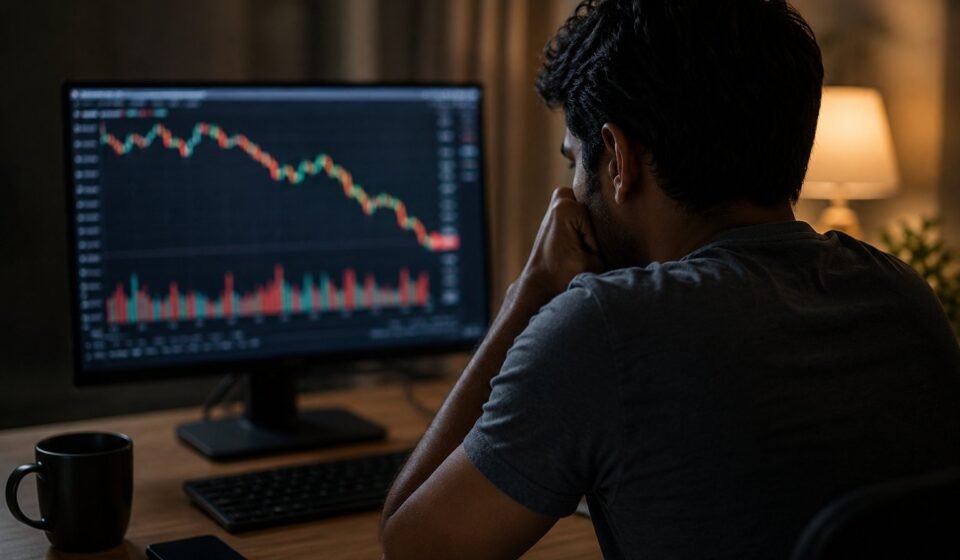

Every time you log in to your broker, a line appears on the screen. Nine out of ten individual traders in equity F&O incurred net losses.
You have scrolled past it a few hundred times.
That line is not marketing and it is not a scare tactic. It comes from SEBI’s own studies of actual trading data across millions of accounts, and it is now a mandated disclosure. This post is about what those studies actually found, and the one result inside them that almost nobody talks about.
What SEBI actually measured
SEBI examined individual trader outcomes in the equity derivatives segment across FY22 through FY25. Not a survey. Not self-reported numbers. Actual trade data.
The headline findings:
- 91 to 93% of individual F&O traders lost money across the studied periods.
- The average loss was around ₹2 lakh per losing trader.
- More than 75% of loss-makers continued trading after their losses.
- A very small group of traders accounted for most of the profits.
Take a moment on the third one. Three out of four people who lost money kept going. That is not a statistic about market knowledge. That is a statistic about behaviour.
The finding that changes everything
Here is the part that rarely makes it into the headlines.
SEBI did not just measure and report. It acted. Lot sizes went up. Weekly expiries were reduced. Position limits tightened. The stated goal was to curb excessive speculative activity by retail traders.
If the cause of losses were too much access, too much leverage, or too many opportunities to gamble, then restricting all three should have shrunk the losses.
Losses widened instead.
That single result does more to explain retail trading than any other number in the study. The traders were not losing because the market was too available. They found a way to lose the same money through a narrower door.
Restricting access changes the venue. It does not change the decision-making that produces the loss.
The four explanations that do not survive the data
“Retail traders do not have enough information.” Indian retail traders have free real-time charts, option chains, open interest data, and more free education on YouTube than any generation before them. Information access has exploded while the loss rate has stayed flat.
“They do not know technical analysis.” Some do not. But the group this blog is written for, traders with two to five years in the market, mostly do. They can identify the setup correctly and still finish the year down. Knowledge and outcome came apart somewhere.
“The market is rigged against retail.” Institutions have real advantages in speed and cost. But that does not explain why the same trader is profitable on paper and unprofitable live, using the same strategy on the same instrument. The rigging theory cannot explain the gap between your backtest and your account.
“They just need better strategies.” This is the most expensive belief in Indian retail trading, because it is the one people spend money on. If strategy were the binding constraint, the traders who have bought five courses would be doing better than the ones who bought none. They are not.
What the data points to instead
Put the findings together and a specific picture forms.
People with adequate information, adequate tools, and adequate strategy access are consistently losing money, continuing after losing it, and losing more even when the regulator makes it harder to trade.
That combination describes an execution problem, not a knowledge problem.
Look at what actually happens in a losing account. It is rarely one catastrophic analysis error. It is:
- A stop loss that was set correctly and then moved.
- A position size that crept up after a loss.
- A winner booked at 1.2R when the plan said 3R.
- A loser held past the stop because closing it made it real.
- Four trades taken on a day the plan called for one.
None of those are analysis failures. Every one of them is a live decision that contradicted a calm decision. Multiply that across a year and you get ₹2 lakh.
Why the losses keep going
The 75% who kept trading after losing are the most interesting group in the study, and the easiest to explain.
A realised loss creates an open loop. Your brain files it as an unfinished task and generates pressure to close it. The market is still open, your capital is still there, and recovery looks available. So the thought is not “I am being reckless.” The thought is “I can make this back.”
That is also why tightening the rules did not help. The urge to close the loop is not sensitive to lot size. Give someone fewer expiries and they will take larger positions in the ones that remain.
There is a documented Indian example that captures the whole pattern. A 28-year-old IT employee in Bengaluru started trading BankNifty options after watching influencers post their profits. He lost ₹45,000 in two weeks. He did not stop. He traded bigger lots to recover.
Nothing in that story is a knowledge failure. He would have told you his lot size was too big. He did it anyway.
What separates the small group that makes money
The profitable minority are not running secret strategies. What they do differently is boring and repeatable:
- They size positions so no single trade can hurt them. This is the largest single lever available and it is available to you today, for free.
- They have a hard stopping rule. A rupee loss limit for the day, decided before the open.
- They let winners reach target. Their average win is meaningfully larger than their average loss, which is what actually produces profitability.
- They judge decisions, not outcomes. A good decision can lose. If you grade yourself on results, the market teaches you the wrong lesson about 40% of the time.
- They stop trading when their state is degraded, and they can tell because they check before the open rather than diagnosing after the loss.
What to do with this
The 93% figure is not a reason to quit. It is a reason to stop looking for the answer in the place you have been looking.
If you have two or more years in the market and you are still not profitable, the highest-return thing you can do is not another strategy. It is a written daily loss limit, a position size cap, and thirty days of honest logging.
Run that test before you buy anything else. Paper-trade your existing system for 30 trades with zero deviations from the plan, then compare to your live results. If the paper version is profitable and the live version is not, you have found your actual problem, and it was never the strategy.
Frequently asked questions
Is the 93% figure accurate?
It comes from SEBI’s analysis of actual trading data in the equity derivatives segment, not a survey, and it has been replicated across multiple financial years with results in the 91 to 93% range. It is now a mandated broker disclosure, so it can be cited with regulatory backing rather than as an internet claim.
Does this mean F&O trading is gambling?
The instrument is not gambling. The way most people use it functionally is. The difference is whether position size, stop placement, and exit are decided in advance by a rule or in the moment by a feeling. Same instrument, entirely different activity.
Why did losses grow after SEBI tightened the rules?
Because the restrictions targeted access, and access was not the cause. Traders responded to fewer expiries and larger lot sizes by concentrating the same behaviour into fewer, larger positions. The decision-making that produces losses was untouched.
If 93% lose, is it worth trading at all?
That depends entirely on whether you are willing to fix the execution layer, because that is what separates the groups. What is not worth doing is trading live, unprofitably, for another year while looking for a better strategy. That is the specific pattern the data describes.
How much capital do I need to survive this?
Capital is less protective than people assume. A larger account with uncapped position sizing produces larger losses, not fewer. The protective factor is the ratio between your position size and your account, not the account itself.
The bottom line
SEBI ran the experiment for us. They restricted access and losses grew. That is as close to proof as retail trading gets that the problem sits between the plan and the click, not in the plan.
The market does not reward better predictions. It rewards better decisions.
Agar decisions badlenge, toh results bhi badlenge.
Related reading:
- The ACE Framework: Aware, Control, Execute Explained
- Mindfulness for Traders: What It Actually Means (Not Just Sitting Still)
- How Long It Actually Takes to Become a Consistently Profitable Trader
- Why Isha Foundation’s Programs Are Popular Among Indian Professionals, Including Traders
- Why You Keep Refreshing the P&L Screen
Want to fix the execution layer? I run a free live session twice a week for traders with two or more years of experience who know the setups but still cannot execute under pressure. Register for the next free session here.
I am Samir Dash, founder of Mindful Trading Hub. I work with experienced traders on live market decision-making. More about my story here.