
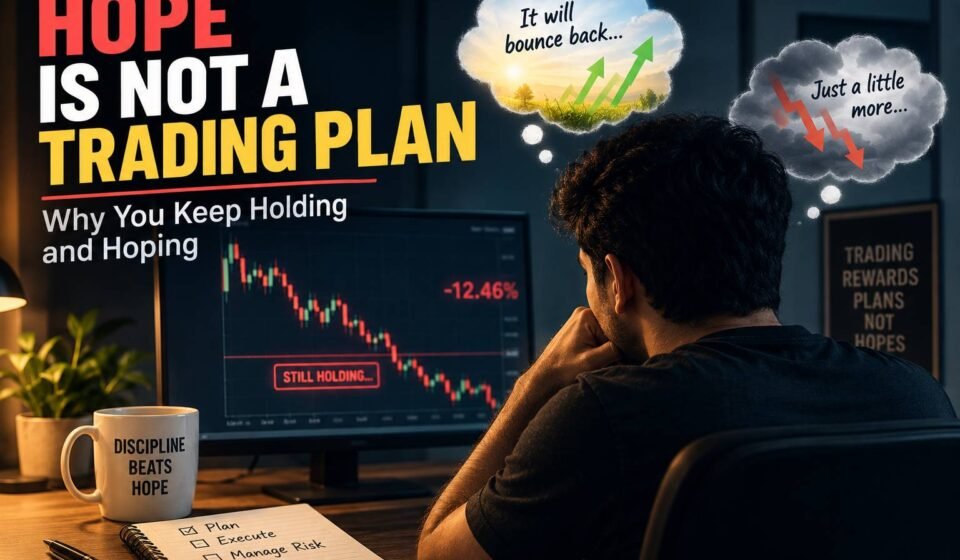

Your stop loss is at 24,720. Nifty futures are trading at 24,735. You bought at 24,850, so you are already down more than your plan allowed you to feel comfortable with. And instead of watching your stop, you find yourself watching the last five minutes of candles, looking for a sign that the fall is slowing down.
That sign you are looking for is hope, dressed up as chart analysis.
What hope actually looks like in a live trade
Hope in trading rarely announces itself. Nobody thinks the words “I am hoping this works out.” Instead, it shows up as a series of small, reasonable-sounding thoughts strung together while price moves closer to your stop.
The common patterns:
- Moving your stop loss slightly further away, “just to give it room.”
- Switching from your five-minute chart to the one-minute chart, looking for a bounce that confirms what you want to see.
- Telling yourself the move is “just a shakeout” without any rule that defines what a shakeout actually looks like.
- Refreshing news or a stock forum, searching for a reason the price should turn around.
- Feeling relief the moment price ticks up one point, even though nothing about the trade has actually changed.
If you recognise two or more of these from your last losing trade, hope was steering, not your plan.
Why hope feels like patience
This is the part that makes hope so hard to catch. Patience is a real and valuable trading skill. It means staying in a trade because your original reasons for the trade are still true. Hope means staying in a trade because leaving feels worse than staying, even though your original reasons are no longer true.
Both feel exactly the same from the inside. Both involve sitting still and waiting. The only difference is what is actually happening in the market versus what you decided in advance would justify staying.
This is why the fix cannot be “trust your gut about whether this is patience or hope.” Your gut cannot tell the difference in the moment. Only a rule written before the trade can.
The mechanism: why your brain avoids the loss becoming real
A loss on your screen, while the trade is still open, is not final. It can still recover. The moment you close the trade, the loss becomes permanent and recorded. Your brain treats these two states very differently, even though the rupee amount might be identical.
An open loss feels reversible. A closed loss feels final. Hope is the mental strategy your brain uses to stay in the reversible state for as long as possible, because the reversible state does not require you to accept anything yet.
This is closely related to why losses hurt roughly twice as much as equivalent gains feel good. The larger that hurt, the stronger the pull to avoid making it official by closing the trade. Hope is not laziness or lack of discipline. It is your brain actively working to postpone a specific kind of pain.
“It’s just testing this level. It always bounces from here.”
That sentence has probably been true before, on a different day, in a different setup. That is exactly why it is so convincing now. Hope always borrows evidence from a different trade to justify staying in this one.
How hope escalates if you do not catch it early
Hope rarely stays small. It has a shape, and the shape gets worse the longer you wait.
- Price nears your stop. You notice, and your attention sharpens.
- You look for a reason to wait. A support level, a moving average, a round number.
- Price touches your stop level but does not close beyond it. This gets read as confirmation your reason was correct.
- You move your stop, or remove it entirely “for now.” The trade is no longer the trade you planned.
- Price breaks through cleanly. The loss is now larger than your original plan allowed, sometimes two or three times larger.
- You close it, angry, and the anger becomes fuel for the next trade.
The expensive step is step 4, moving the stop. Everything before that is normal human behaviour. Step 4 is where a plan-based trader and a hope-based trader permanently diverge in outcome.
Why hope is more dangerous in a winning trade too
Hope is usually discussed only in the context of losing trades, but it shows up in winners as well, in a quieter way. When a trade is in profit, hope becomes “let it run a bit more, it could be a much bigger winner than my target allows.”
This version feels positive, which makes it even harder to catch. But it is the same mechanism. You are replacing a written target with a feeling about what might happen, because staying in feels more exciting than the certainty of booking the planned gain. See Should I Book Partial Profits or Let It Run? for how to handle this without either hoping or cutting a good trade short.
What actually replaces hope
You cannot argue yourself out of hope in real time. It does not respond to logic, because it does not present itself as illogical. What works instead:
- A written invalidation condition decided before entry, in specific price terms, not a feeling. “If price closes below 24,720 on the five-minute chart, I am out.”
- A rule against moving stops further away, ever, under any circumstance. Stops can only move in your favour, never against you.
- A hard cap on how many times you check the trade per hour. Fewer checks means fewer chances for hope to build a new story.
- A one-line journal entry the moment you feel the urge to wait “a bit longer.” Writing the urge down, in the moment, often exposes it for what it is.
None of these require you to feel calm. They require the decision to already be made, so hope has nothing left to negotiate with.
A real example, worked through in numbers
Say you short Bank Nifty at 51,200 with a stop at 51,320, a risk of 120 points. Your target is 50,900. Price moves to 51,280, only 40 points from your stop. This is where hope usually shows up.
You notice a small wick on the five-minute chart and decide it looks like a rejection. You move your stop to 51,350, adding 50 points of risk that was never part of your original plan. Price stalls, moves your way for a few minutes, then resumes climbing and closes above 51,350. Your actual loss is now 150 points, not the 120 you had accepted when you placed the trade.
The extra 30 points did not come from the market being unpredictable. They came from a single decision, made under discomfort, to override a number you had already written down. Multiply that 30-point gap across a month of similar trades and you can see why hope, quietly, is often the single most expensive habit in a trader’s month, even more expensive than one clearly bad revenge trade, because it happens so often that it stops looking like a mistake.
Frequently asked questions
How do I know if I am being patient or just hoping?
Check your original reasons for the trade against current price action. If your setup is still valid and your stop has not been hit, that is patience. If you are looking for new reasons that were not part of your original plan, that is hope.
Is it wrong to ever move my stop loss?
Moving a stop closer to lock in profit is fine and often smart. Moving a stop further away from your entry, after the trade is already open, is almost always hope, not strategy.
Why do I only feel hope on losing trades, not winning ones?
Hope shows up on winning trades too, just in a different form. It becomes “let it run further,” replacing your written target with a feeling. It is quieter because it does not involve pain, but it is the same avoidance of a decided plan.
Does hope mean I have a weak trading mindset?
No. Hope is a normal response to the discomfort of an open loss becoming permanent. Every trader experiences it. The difference between traders is whether a written rule intercepts it before the stop gets moved.
What is the fastest way to catch hope in the moment?
Ask one question: did I write this exact reason down before I entered the trade? If the answer is no, the reason arrived after the fact, which means it is very likely hope, not analysis.
The real point
Hope is not a character flaw. It is what your brain does automatically to delay an uncomfortable, final decision. Left alone, it will always choose comfort over your plan.
The fix is not to feel less hope. It is to remove the decision from the moment where hope operates, and hand it instead to the version of you who wrote the plan before the trade began.
The market does not reward better predictions. It rewards better decisions.
Ummeed trade ka plan nahi hoti, plan hi trade ka sahara hota hai.
Related reading:
- Fear of Loss in Trading: Why You Cannot Pull the Trigger
- Greed in Trading: What It Actually Feels Like in a Live Trade
- How to Make Calm Decisions While a Trade Is Still Open
Want to break this loop properly? I run a free live session twice a week for traders with two or more years of experience who know the setups but still cannot execute under pressure. Register for the next free session here.
I am Samir Dash, founder of Mindful Trading Hub. I work with experienced traders on live market decision-making. More about my story here.