
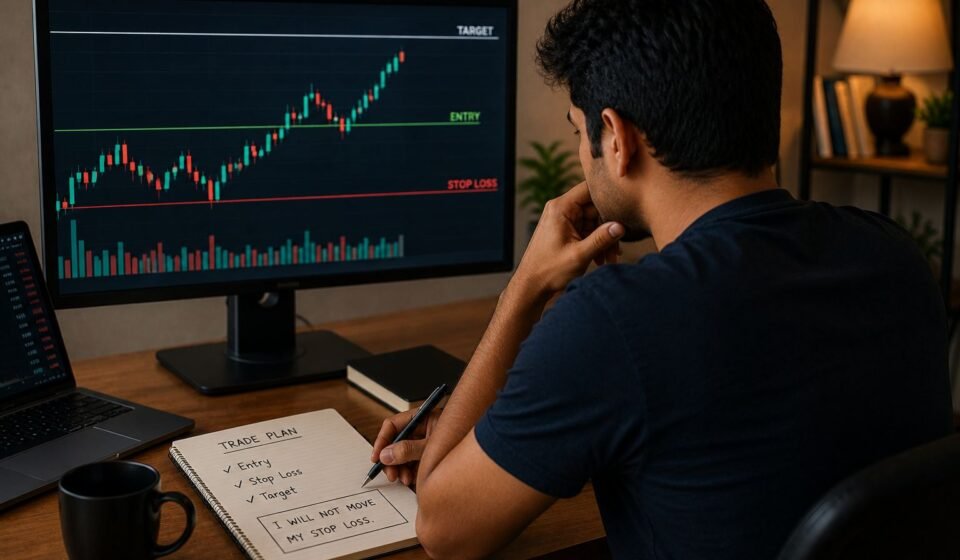

Most advice about stop losses is about discipline. Hold your stop. Do not move it. Be strong.
That advice skips the more useful question, which is why the stop was so hard to hold in the first place.
In practice, most moved stops were placed badly before the trade even started. Get the placement right and holding it stops requiring willpower, because there is much less to resist.
The two ways people place stops, and why one fails
Method one: place the stop at a distance you are comfortable losing. You are willing to lose ₹2,000, so the stop goes wherever ₹2,000 lands on the chart.
This is what most traders do and it is backwards. The market has no idea what you are comfortable with. A stop placed at a comfortable distance rather than a meaningful one sits in the middle of ordinary noise, so it gets hit constantly by moves that mean nothing.
Then something worse happens. You get stopped out three times on trades that would have worked, and you conclude that stops themselves are the problem. That conclusion is how traders end up trading without stops at all.
Method two: place the stop where your idea is proven wrong. Then size the position so that distance costs an acceptable amount.
This is the correct order and it is the whole article. Placement is a chart decision. Size is a money decision. Doing them in that order fixes most stop-loss problems by itself.
Where the stop actually belongs
The stop goes at the price where the reason you entered is no longer true.
Not near it. Beyond it, with room for noise.
Ask yourself before entering: what would price have to do to prove this idea wrong? Then put the stop past that point.
- Entering on a break of structure? The idea is wrong if price closes back inside the structure. Stop goes beyond the structure, not at its edge.
- Entering at support? The idea is wrong if support fails. Stop goes below the low that formed the support, with a buffer, not at the exact level.
- Entering on a trend pullback? The idea is wrong if the pullback becomes a reversal. Stop goes beyond the prior swing point.
The buffer matters. Placing your stop exactly at the obvious level puts it in the same place as everyone else’s, which is precisely where price tends to reach before reversing. A stop two points inside the level is not protection, it is a donation.
Use ATR to size the buffer
If you want one mechanical improvement to stop placement, this is it.
Average True Range tells you how far this instrument typically moves in a given period. It converts “give it some room” from a feeling into a number.
A practical approach: find your invalidation level, then place the stop a fraction of ATR beyond it. Half an ATR is a reasonable starting point on intraday timeframes.
Two reasons this helps beyond the arithmetic. It adapts automatically when volatility changes, so your stop is wider on violent days and tighter on quiet ones without you deciding anything. And because it is calculated rather than felt, it is much harder to argue with mid-trade.
There is a related finding worth knowing. Stops placed at the low or high of the entry candle, which is extremely common, tend to perform meaningfully worse than ATR-based stops. The entry candle’s extreme is an arbitrary point that has no particular significance to the market. It is convenient, not meaningful, and convenience is not a risk parameter.
Then size the position around it
This is the step that makes the whole thing work, and it is the step most traders skip.
Once the stop is placed correctly, the distance is what it is. Now the only variable left is size.
The formula:
Position size = rupees you are willing to risk ÷ distance to stop
Worked example. Daily loss limit ₹6,000. Maximum single-trade risk is a third of that, so ₹2,000. Your correctly-placed stop is 40 points away. Position size is 50 units.
If the correct stop is 80 points away instead, position size is 25 units. Same risk in rupees, different size. The stop did not move to accommodate your preferred size. The size moved to accommodate the correct stop.
This is the entire discipline of stop placement in one sentence: when the stop needs to be wider, trade smaller, not closer.
Make it an order, not an intention
Place the stop as a live resting order at the moment you enter. Same click sequence, every time, no exceptions.
A mental stop is not a stop. It is a plan to make a decision later, and later is precisely when you will be least equipped to make it. The entire purpose of a stop is to move the exit decision out of the live moment. A mental stop leaves it exactly where the problem is.
If you take one thing from this post, take this one. It requires no skill and no judgment, and it eliminates the majority of stop-loss failures on its own.
Five placement mistakes
1. Round numbers
Stops at 25,000 or 1,500 sit where everyone else’s sit. Price reaches obvious clusters. Go past them.
2. The entry candle’s extreme
Common because it is easy. It has no structural meaning and it measurably underperforms an ATR-based stop.
3. Fixed point stops regardless of conditions
A 30-point stop is loose on a quiet day and meaningless on a volatile one. Same number, entirely different risk.
4. Stops sized to your desired position rather than the chart
If you decided the size first and then found a stop that fits it, you have inverted the process. The chart determines the stop. Your risk limit determines the size.
5. No stop at all on “small” positions
Small positions become large ones through averaging down. Every position gets a stop, without exception, because the exception is where the account damage comes from.
A checklist before you enter
Five questions, roughly fifteen seconds:
- What would prove this idea wrong? (That price is your stop level.)
- Have I added a noise buffer beyond it?
- What is the distance in points?
- What size does that distance allow, given my risk limit?
- Is the stop entered as a live order?
If question 4 gives you a size that feels too small to be worth trading, that is real information. It means the setup requires more risk than it is worth at your account size. Skipping the trade is a legitimate answer, and a better one than tightening the stop until the size looks appealing.
Frequently asked questions
How wide should my stop be?
There is no universal number, and any source giving you one is guessing. The width is determined by where your idea is invalidated on that specific chart plus a volatility buffer. It changes by instrument, timeframe, and day.
My stops keep getting hit and then price goes my way. What am I doing wrong?
Almost always placement rather than bad luck. Your stop is likely inside the noise range or at an obvious level. Measure ATR on your timeframe and compare it to your typical stop distance. If your stop is smaller than one ATR, it is being hit by ordinary movement, not by anything meaningful.
Should I use a trailing stop?
Useful for letting winners run, but define the trail mechanically before entry, for example trailing by 1.5 ATR or below each completed swing. A trail you adjust by feel during the trade is just an early exit with extra steps.
Can I use a time-based stop instead?
Yes, as an addition rather than a replacement. “If this has not moved in my favour within 30 minutes, I close it” is a legitimate rule that protects capital efficiency. You still need a price stop for the case where it moves against you quickly.
What if the correct stop is too wide for my account?
Then the trade is not available to you at this account size, and that is a real constraint rather than a problem to solve with a tighter stop. Trade a smaller instrument, a longer timeframe, or skip it. Forcing the stop closer does not reduce your risk, it just guarantees you get stopped out.
The bottom line
A stop you keep moving is usually a stop that was placed to fit your position size instead of the chart.
Reverse the order. Find where your idea dies, add a noise buffer, then let the size fall out of the arithmetic. Placed that way, the stop stops being something you have to resist.
Stop loss chart decide karta hai. Size aap decide karte hain.
Related reading:
- Risk Management Rules That Actually Get Followed
- When to Exit a Trade: The Decision Framework Most Traders Skip
- The ACE Framework: Aware, Control, Execute Explained
Want help getting this right? I run a free live session twice a week for traders with two or more years of experience who know the setups but still cannot execute under pressure. Register for the next free session here.
I am Samir Dash, founder of Mindful Trading Hub. I work with experienced traders on live market decision-making. More about my story here.