

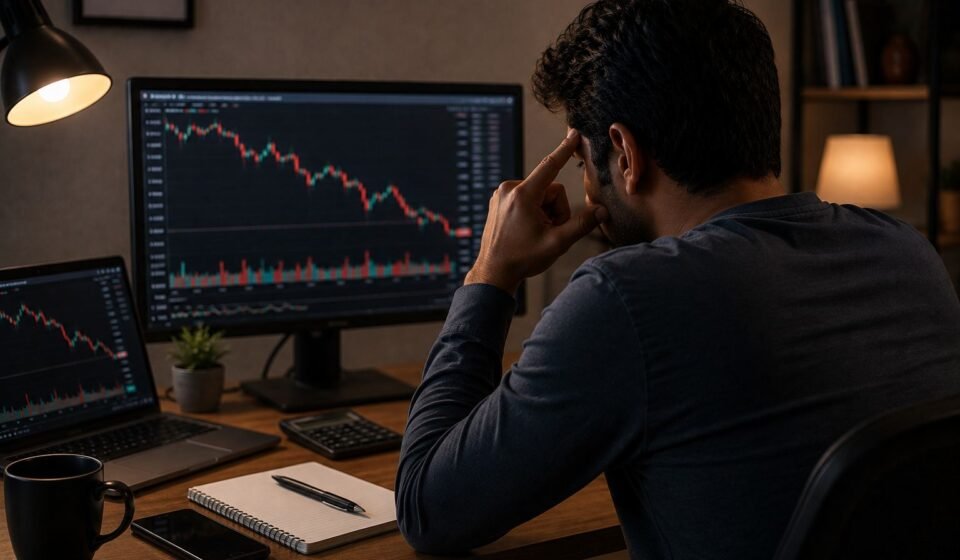

You lost ₹8,000 on the first trade. The next trade you took was double the size.
Nobody had to tell you to do that. It happened on its own, and at the time it felt like arithmetic rather than emotion. If a normal-sized trade will not recover ₹8,000 quickly, a bigger one will. That is just true.
It is also the single fastest way to turn a bad morning into a bad quarter. This post is about why the arithmetic is wrong and what to do instead.
The maths that feels right
Let us take the reasoning seriously first, because it is not stupid.
You are down ₹8,000. Your normal trade risks ₹2,000 to make ₹6,000. Recovering at normal size requires more than one clean win, plus time you may not have before the session ends.
Double the size and one win puts you flat. The logic holds.
What the logic leaves out is what happens when it does not work, and the reason it leaves that out is that you are not currently able to think about it.
The maths that is actually happening
Run both branches instead of one.
Normal size, ₹2,000 risk. Lose again and you are down ₹10,000. Recoverable inside a week of ordinary trading.
Double size, ₹4,000 risk. Lose again and you are down ₹12,000, and here is the part that matters: you are now more agitated than you were before, so the next size will be larger again. That is the actual sequence.
Typical escalation from a single ₹8,000 loss:
- Trade 2 at 2x risk. Loses. Down ₹12,000.
- Trade 3 at 3x risk. Loses. Down ₹18,000.
- Trade 4, sized to “just fix it.” Down ₹30,000 or worse.
Your original loss was 1R. Half an hour later you are down 6R or more. If your system produces +0.6R per trade, you just deleted your next ten trades, which is roughly two weeks of correct work.
The doubling logic optimises for the branch where you win. The escalation happens on the branch where you do not, and that branch is where the account actually dies.
Why your brain sizes it that way
The real reason is not arithmetic at all.
Losses register roughly twice as strongly as equivalent gains. Down ₹8,000, you are not experiencing an ₹8,000 problem. You are experiencing something closer to a ₹16,000 problem, because that is what the feeling weighs.
So when you size the recovery trade, you are not sizing it against the number on the screen. You are sizing it against the feeling. And the feeling is roughly double.
That is why the recovery trade is almost never 1.2x. It is 2x or 3x. The size is calibrated to how bad it feels, and it feels twice as bad as it is.
Why this is not the same as scaling
There is a legitimate version of varying position size, and it is worth separating clearly so you do not use it as cover.
Legitimate: size varies by setup quality, defined in advance. Your A-plus setup gets 1.5x, your B setup gets 0.5x, and which is which was decided before the session. Volatility-adjusted sizing also qualifies, because it is calculated from ATR rather than felt.
Not legitimate: size varies by how the last trade went. That is not a rule, it is a mood with a number attached.
The test is simple. Could you have written down this size before you knew the outcome of the previous trade? If yes, it is a system. If no, it is loss aversion doing your risk management.
The Martingale trap
What you are doing has a name in gambling, and it is worth knowing it.
Martingale is doubling your stake after every loss so that one win recovers everything. It works on paper because a win eventually arrives. It fails in practice for two specific reasons that also apply to your account.
First, position limits. Your capital is finite, and the required size grows exponentially. Six consecutive losses starting at ₹2,000 needs ₹128,000 on the seventh trade.
Second, and more relevant, in trading the losses are not independent. In roulette the wheel does not care about your last spin. In trading, a losing streak is often information that market conditions have changed and your setup is not working today. Martingale assumes the next event is unrelated to the last one. In markets it frequently is related, which means you are increasing size exactly when your edge is weakest.
The fix: a cap that makes it impossible
Willpower does not work here, because the decision happens in the state least able to apply willpower. Use a structural cap instead.
1. Write a daily loss limit in rupees, before the open
An actual number on paper. “If I am down ₹8,000 today, I stop.”
2. Cap single-trade risk at one third of that limit
This is the rule doing the heavy lifting. With an ₹8,000 daily limit, no trade risks more than ₹2,667. Now three consecutive losses are required to hit your limit, which gives you two separate chances to notice the pattern before it is over.
More importantly, it makes doubling structurally impossible. If your normal risk is already at the cap, there is nothing to double into.
3. Fix your size for the whole session before it starts
Decide your lot size in the morning and do not change it during the day for any reason. Not after a loss, not after a win, not because a setup “looks especially good.”
Any mid-session size change is the behaviour this post is about, regardless of what justification arrives with it.
4. If you must vary size, vary it downward only
A workable compromise if you cannot accept a fixed size. You may reduce size at any time. You may never increase it during a session. This preserves the ability to protect yourself while removing the ability to escalate.
5. Two strikes and the terminal closes
Two consecutive full stop-outs and you are done for the day. This caps the sequence at stage two, before size has a chance to escalate.
What to do when you notice the urge
You will still feel it. The point is what happens next.
When you find yourself reaching for a larger size, do one thing: say the number out loud. “I am about to risk ₹6,000 to recover ₹8,000.”
Saying it converts the decision from a feeling into a sentence, and sentences are much easier to evaluate. Most traders do not complete the trade after hearing themselves say it.
If that fails, stand up and leave the screen for 20 minutes. The specific setup tempting you will not be there when you get back, which is the point.
Frequently asked questions
Is it ever correct to increase size after a loss?
Only if the size was determined by a rule that was written before the loss and does not reference it. For example, a volatility-based model can legitimately produce a larger position after a losing trade because volatility contracted. That is the calculation changing, not you.
What about averaging down on an open position?
Different mechanism, same underlying problem. Averaging down is planned only if it was defined before entry, with a total risk that stays inside your limit. If you decided to add while the position was already against you, that is this article’s behaviour in a different form.
My loss was caused by bad luck, not a bad trade. Can I size up on the next one?
No, and the reasoning is worth understanding. If the previous trade was correctly executed, then nothing about your edge has changed, so there is no basis for changing size. The urge to size up after an unlucky loss is the clearest possible sign that the sizing is emotional, because by your own account nothing informative happened.
How do I recover the loss then?
At normal size, across the following days. This is the answer nobody likes. An ₹8,000 loss recovers in four winning trades at your normal size, which is an ordinary week. Trying to recover it in an hour is what turns ₹8,000 into ₹30,000.
The bottom line
Your position size after a loss is the most honest measurement available of whether you are trading your plan or your feelings. It is a single number and it cannot be argued with after the fact.
Cap it before the market opens, and the most expensive decision in trading becomes unavailable to you.
Aap market ko control nahi kar sakte. Apne size ko kar sakte hain.
Related reading:
- Fear of Loss in Trading: Why You Cannot Pull the Trigger
- Averaging Down: Why It Feels Smart and Rarely Is
- What Happens in Your Brain While a Trade Is Open
Want help building these limits? I run a free live session twice a week for traders with two or more years of experience who know the setups but still cannot execute under pressure. Register for the next free session here.
I am Samir Dash, founder of Mindful Trading Hub. I work with experienced traders on live market decision-making. More about my story here.