

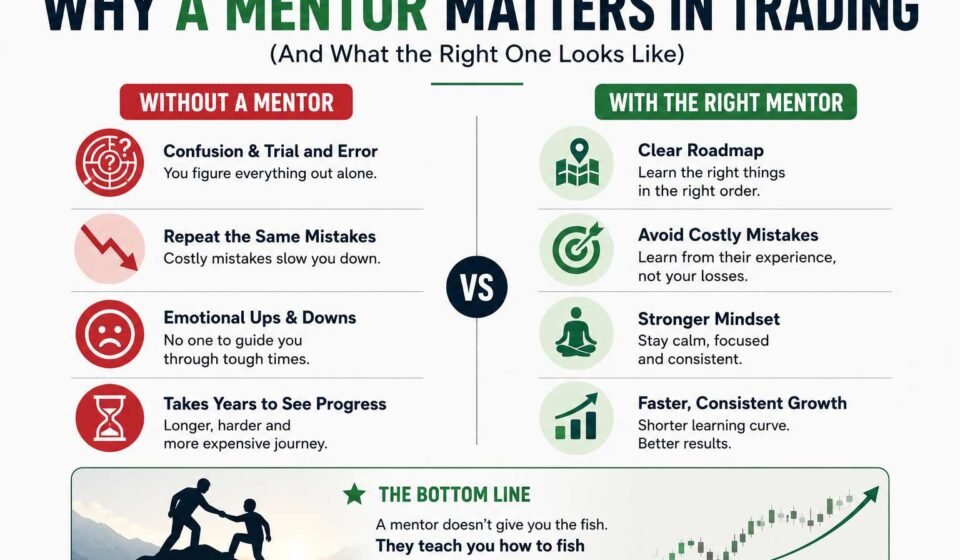

Most traders try to fix their trading completely alone. They read books, watch hours of YouTube, join a few Telegram groups, and quietly assume that if they just study hard enough, the losses will stop on their own. For a lot of traders, this works for a while. Then it stops working, and it stops working for years, not weeks.
This post is about why that happens, and why a mentor changes it in a way that more information usually cannot.
Why studying alone has a ceiling
Technical analysis, strategy, and setups can genuinely be learned from books and videos. Nobody needs a mentor to learn what a support level is or how a moving average is calculated. That part of trading is information, and information is available for free everywhere.
The part that does not show up in a book is what happens to that same information at 11:40 AM when your position is down 1.5% and your hand is on the mouse. In that moment, knowledge does not execute itself. A decision has to be made, under real pressure, with real money on the line, and that decision is shaped by things a course never touches: how you were raised to think about money, how you handle uncertainty, what a loss actually feels like in your body, and what story you tell yourself about why this time is different.
You cannot read your way out of a blind spot. By definition, a blind spot is something you cannot see from where you are standing. That is exactly the gap a mentor fills, not by teaching you a new setup, but by seeing the pattern in your own behaviour that you are too close to see yourself.
What a mentor actually does that self-study cannot
- Names the real problem, not the surface one. A trader often blames the strategy for a string of losses. A mentor who has watched enough trades can often see that the strategy was fine and the exits were being taken 40 seconds too early, every single time, out of fear.
- Shortens the feedback loop. Left alone, a trader might repeat the same mistake for a year before connecting the dots. A mentor who reviews the pattern regularly can flag it after a week.
- Provides accountability that self-discipline alone struggles to provide. Most traders already know their own rules. Knowing a rule and following it under pressure are two different skills, and the second one is far easier to build when someone else is actually checking.
- Normalises the experience. A lot of what feels like a personal failure (revenge trading, moving a stop loss, freezing at entry) is extremely common. Hearing that from someone who has seen hundreds of traders go through it removes a layer of shame that otherwise just adds more pressure on top of the original mistake.
Why this matters more for experienced traders, not less
There is a common assumption that mentorship is for beginners and that traders with a few years of experience should already be past needing one. In practice, the opposite is often true.
A beginner’s problems are usually about knowledge. They do not know what a stop loss is, or how options pricing works, or what a candlestick pattern means. Those gaps close relatively fast with study.
An experienced trader’s problems are usually not about knowledge at all. They already know the setups. They can explain risk management correctly to someone else. Their actual gap is behavioural: the setup was right and they still hesitated, or they still doubled the position size after a loss even though they know that rule by heart. Behavioural gaps are much harder to see and fix alone, precisely because the trader already looks competent on paper. A mentor’s real value increases with experience, not the other way around.
“I know exactly what I’m supposed to do. I just don’t do it when it matters.”
That sentence, in some form, is one of the most common things an experienced trader eventually says out loud. It is also usually the exact moment where self-study alone has already been tried and has not worked.
How to tell a real mentor from a bad one
Not everyone calling themselves a trading mentor is offering the same thing, and the difference matters a lot before you commit time or money to one.
Signs worth trusting
- They ask about your actual trades and behaviour before offering advice, rather than pitching the same program to everyone.
- They talk about their own mistakes and losses honestly, not just their wins.
- They separate strategy questions from psychology and decision-making questions, and are clear about which one they are actually helping with.
- They are upfront that this takes real time and consistency, not a shortcut.
Signs worth questioning
- Screenshots of profit with no explanation of process, risk, or how many losing trades sat around it.
- A promise of a specific return or income figure within a specific timeframe.
- Pressure to decide immediately, with urgency used as the main selling tool.
- No real explanation of what a session or the program actually involves, just testimonials.
What working with a mentor actually looks like
The idea of mentorship can sound vague until you break it into what it actually involves week to week.
- You bring real trades, not hypotheticals. A useful mentor session is built around what you actually did this week, including the trade you are embarrassed about, not a general question about strategy.
- The mentor looks for the pattern, not the single trade. One bad exit is a mistake. The same bad exit five times in a row, always after a loss, is a pattern, and patterns are what actually get fixed.
- You get a specific, small change to work on, not a full overhaul. Trying to fix everything at once rarely works. A good mentor picks the one rule that will move the needle most and has you work on that alone for a stretch.
- You come back and report on it honestly. This is the accountability part, and it is often the part that makes the biggest difference, simply because someone is actually going to ask.
None of this requires the mentor to predict the market better than you do. Their job is not prediction. It is watching your decisions closely enough, over enough repetitions, to see what you cannot see about your own patterns from the inside.
What I try to do differently at Mindful Trading Hub
I started trading in 2018. For the first several years, every teacher I found, and there were many, only taught the technical side: setups, indicators, chart patterns. Nobody was teaching the part that was actually breaking my results, which was what happened in my own head the moment a trade went live. It took me five to six years of real losses, not just in money but in confidence and in trusting myself, to understand that the missing piece was never another setup. It was decision-making under real pressure.
That is the entire reason Mindful Trading Hub exists, and the reason the ACE framework (Aware, Control, Execute) is built the way it is. It is not a strategy course. It assumes you likely already have a strategy that works on paper. What it addresses is the specific gap between knowing that strategy and actually executing it when your own money and your own nerves are involved.
I am also deliberate about not positioning this as guidance from someone who has “arrived” and is now teaching from above. I am not a guru standing over anyone. I am a trader who nearly lost himself to this exact problem, who is still doing this inner work personally, walking a few steps ahead of the traders I work with, not above them. The traders I work with best are usually people much like I was: middle-class, married, carrying real responsibility, who already know the market and are stuck inside their own head rather than stuck on strategy.
The market does not reward better predictions. It rewards better decisions. A good mentor’s entire job is helping you make more of those, consistently, especially on the days it is hardest to.
Frequently asked questions
Do I really need a mentor if I already know technical analysis well?
Knowing technical analysis and executing it consistently under pressure are different skills. Most experienced traders who feel stuck are stuck on the second one, not the first, which is exactly where a mentor tends to add the most value.
Isn’t a trading mentor the same as a course?
Not usually. A course delivers information in one direction. Mentorship involves someone actually looking at your specific trades and behaviour and responding to your specific patterns, which a pre-recorded course cannot do.
How do I know if a mentor is legitimate before committing?
Look for how they talk about their own losses and process, not just their wins, and whether they take time to understand your actual trading before offering advice. Pressure to decide immediately and vague promises of returns are the two biggest warning signs.
Can mentorship really change behaviour that has been the same for years?
It can, though it is rarely instant. The pattern usually formed over years, so it reasonably takes real weeks and months of consistent work to change, not one session. What a mentor changes fastest is usually not the behaviour itself but the trader’s ability to actually see the behaviour clearly, which is the necessary first step.
The real point
You do not need a mentor to learn what a stop loss is. You need one for the part no book can teach you: seeing your own blind spot clearly enough to actually change what you do the next time it matters.
Akela seekhne ki koshish mein bahut saal nikal jaate hain. Sahi guide ke saath, wahi seekhna jaldi hota hai.
Related reading:
- How to Choose the Best Trading Coach in India: A Complete Evaluation Guide
- What Is a Trading Decision Coach? (And Why It Is Different From a Strategy Coach)
- Samir Dash: Founder of Mindful Trading Hub, His Story and Approach
If this describes where you are, you do not have to keep working through it alone. I run a free live session twice a week for traders with two or more years of experience who know the setups but still cannot execute under pressure. Register for the next free session here.
I am Samir Dash, founder of Mindful Trading Hub. I work with experienced traders on live market decision-making. More about my story here.