
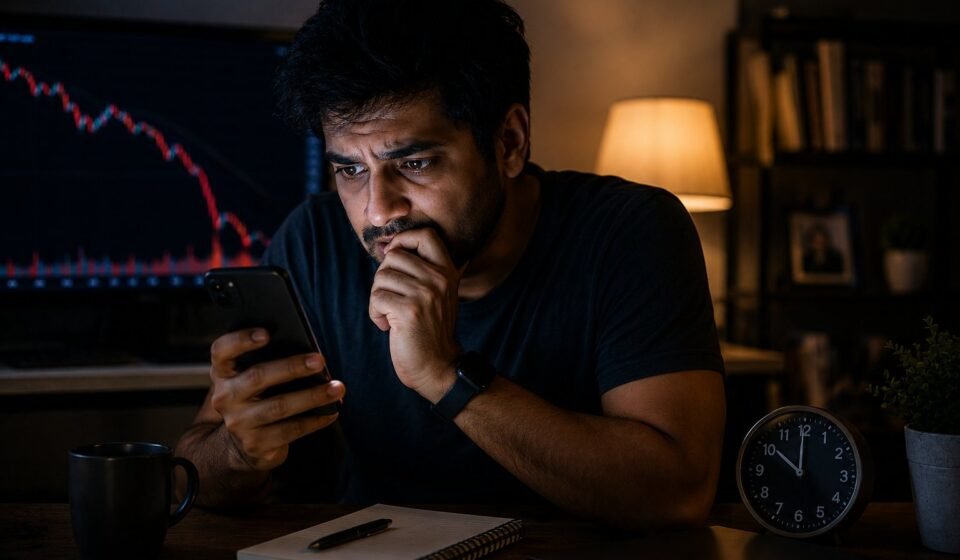

Checking your portfolio every five minutes is not really about wanting information. Refreshing an app that has not meaningfully changed since the last refresh does not give you anything new to act on. What it gives you is a brief hit of relief or anxiety, and your brain has learned to chase that, regardless of whether it helps your trading at all.
What is actually happening when you refresh
Every time you open the app and see a number, your brain gets a small, quick result. Green, and there is a flash of relief. Red, and there is a flash of unease that often pushes you to check again soon, as if checking again might change the outcome. Neither response requires you to do anything with the information. The checking itself has become the activity, separate from any decision it might lead to.
This pattern is similar to how people check phones for messages, refresh social media, or reload a cricket score during a close match. The action is quick, the reward or discomfort is immediate, and the brain learns to repeat whatever produces a fast response, regardless of whether the response is useful.
Why this specific habit is worse for traders than for phone checkers
Checking a social media feed too often wastes time. Checking a live portfolio too often actively degrades trading decisions, for a few concrete reasons.
- It pulls you toward reacting to noise. A five-minute price swing on most stocks is statistical noise, not information. Watching it closely makes normal, meaningless fluctuation feel like a signal that demands a response.
- It shortens your actual holding period. A trade planned as a multi-day swing can quietly turn into a same-day exit simply because watching the number bounce around for six hours becomes uncomfortable, even though nothing about the original setup has changed.
- It manufactures reasons to act. The mind does not like sitting with an unresolved feeling. If you are watching a red number, some part of you will start looking for a reason to do something about it, whether that is closing early, averaging down, or opening a new trade to distract from the discomfort.
The mechanism behind the pull
The core driver is uncertainty. An open position is an unresolved outcome, and unresolved outcomes generate a pull toward closure, the same open-loop mechanism that drives revenge trading after a loss. Checking the portfolio feels like managing the uncertainty. In reality, checking does nothing to resolve it. The outcome resolves on its own timeline, not on the timeline of how often you look at it.
“I’ll just check once more, then I’ll leave it alone.”
That thought rarely holds for more than a few minutes, because the checking itself is what generates the temporary relief, and the relief fades quickly enough that the pull to check again returns before long.
How this connects to averaging down and overtrading
Frequent checking does not just waste attention. It actively feeds other mistakes. Watching a position dip repeatedly across a day makes the price look increasingly like a “deal,” which is a large part of what drives averaging down: why it feels smart and rarely is. And the discomfort of watching an open position too closely often pushes traders to open a second, unrelated position simply to feel like they are doing something productive instead of just watching, which quietly turns into overtrading.
What actually helps
Set a fixed number of check-in times
Instead of leaving the app open all day, decide on two or three specific times to check, for example at the open, around midday, and near the close. Between those times, close the app entirely rather than leaving it minimised where a glance is always one tap away.
Turn off non-essential notifications
Price alerts tied to your actual stop and target levels are useful. General notifications for every percentage move are not. The second kind trains the same checking habit through a different door, because each notification creates a fresh pull to open the app and look.
Match your checking frequency to your holding period
A trade held for weeks does not need five-minute price checks. A rule worth adopting: check no more often than your intended holding period reasonably requires. A swing trade with a multi-day target does not need intraday monitoring beyond confirming the stop has not been hit.
Separate monitoring from managing
Set your stop loss and target as actual orders in the system wherever possible, rather than mental levels you plan to act on manually. This removes the need to watch continuously, because the exit will happen on its own if the price reaches it, whether or not you are looking at the screen at that exact moment.
Notice what you are actually seeking
The next time the urge to check hits, pause for a moment and name what you are hoping to feel, usually relief or certainty. Naming it does not remove the urge instantly, but it separates the urge from the belief that checking will genuinely produce useful information, which is often enough to let the urge pass without acting on it.
Why this matters more during a winning streak than people expect
Constant checking is usually associated with anxiety after a loss, but it shows up just as often during a good stretch, driven by a different feeling, the fear of losing back gains that are not yet booked. This overlaps closely with the pattern covered in why a winning month makes your next month worse, where the discomfort of protecting unrealised gains pushes traders into decisions that end up costing them the very gains they were trying to protect.
What to do with the time you free up
Cutting down on checking usually opens up a surprising amount of time and attention during market hours, and what fills that gap matters. Simply sitting with the discomfort of not checking, with nothing else to focus on, often just delays the urge rather than removing it.
A few approaches that tend to work better than sitting idle. Use the freed time for the next day’s preparation, reviewing your watchlist or planning tomorrow’s levels, so the attention goes toward useful trading work rather than toward the open position you are trying not to watch. Step away from the desk entirely between your scheduled check-in times, since physical distance from the screen removes a large part of the temptation that proximity creates. If the job or household allows it, batch other tasks, calls, errands, family time, into the exact windows when you would otherwise be refreshing the app, so the habit gets replaced with something concrete rather than left as an empty space.
The goal is not to develop willpower strong enough to resist looking at a screen that is sitting right in front of you. It is to arrange the day so the temptation is not sitting in front of you as often in the first place.
Frequently asked questions
Is checking my portfolio often actually harmful, or just a waste of time?
Both. It wastes attention, and it actively increases the chance of reacting to normal price noise as if it were meaningful information, which tends to produce worse decisions than watching less closely.
How often should I actually check my open positions?
A reasonable guide is to match your checking frequency to your holding period. Intraday trades need closer attention within the session. Swing or positional trades usually need no more than a check at the open and the close.
Why do I feel anxious when I am not checking my portfolio?
Because the checking habit has been reinforced enough times that not checking now feels like something is being left unmanaged, even when there is genuinely nothing actionable to manage in that moment.
Does closing the app actually help, or will I just check another way?
It helps meaningfully for most people, especially combined with removing non-essential notifications. The friction of having to reopen an app is often enough to interrupt the automatic habit loop.
Is it different if I am a full-time day trader?
Yes, active intraday trading genuinely requires closer monitoring during market hours. The habit described here mainly targets checking outside of active decision windows, and checking swing or positional trades as if they were intraday ones.
The real point
A number on a screen refreshing every few minutes is not new information most of the time. It is a habit your brain has learned to repeat because it produces a quick emotional response. The fix is not more willpower while looking at the screen. It is looking at the screen less often in the first place.
The market does not reward better predictions. It rewards better decisions.
Baar baar dekhne se number nahi badalta, sirf mann aur bechain hota hai.
Related reading:
- Revenge Trading: Why You Keep Trying to Win It Back
- When to Exit a Trade: The Decision Framework Most Traders Skip
- Overtrading: The Habit That Quietly Empties Accounts
Want to break this loop properly? I run a free live session twice a week for traders with two or more years of experience who know the setups but still cannot execute under pressure. Register for the next free session here.
I am Samir Dash, founder of Mindful Trading Hub. I work with experienced traders on live market decision-making. More about my story here.