
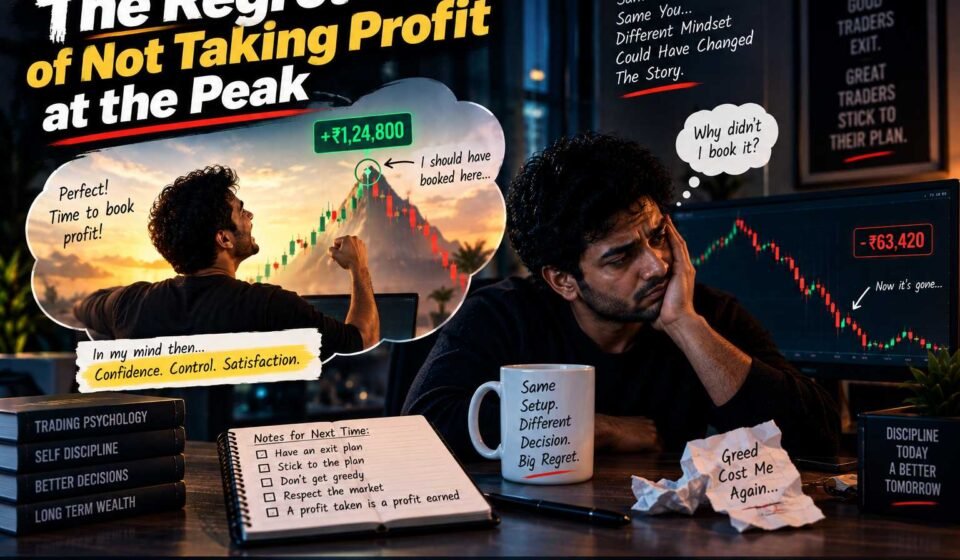

At 11:14 your position was up ₹22,000. You saw the number. You did not book it. At 11:40 you finally exited at ₹8,000, and you have replayed the number 22,000 at least fifteen times since then. Not the 8,000 you actually made. The 22,000 you did not take.
This is a very specific kind of regret, different from the regret of a losing trade, and it can sit with a trader for days, well after the money involved has stopped mattering financially.
What this regret actually is
The regret of not taking profit at the peak is the distress that comes from having seen your maximum unrealised gain on a trade and not acting on it, so the version of the outcome you actually got feels like a loss compared to the version you saw and passed on.
Financially, you still made money. ₹8,000 is a real, positive number. Psychologically, the trade can feel like a failure, because your brain is comparing the outcome not to zero, but to the highest number it briefly saw on screen.
Why the peak becomes the reference point instead of zero
Normally, a trader’s sense of success is measured against their entry, the number where the trade started. But once your unrealised profit reaches a new high point, that high point quietly becomes the new reference your brain measures against, even though you never had that money in hand and it was never guaranteed.
This is why an ₹8,000 profit that peaked at ₹22,000 feels worse than an ₹8,000 profit that only ever reached ₹9,000. Same actual result. Completely different feeling, because the comparison point moved.
The mechanism is closely related to loss aversion. Once your brain files 22,000 as “what this trade was worth,” the gap between 22,000 and 8,000, which is 14,000, gets processed emotionally as a loss of that size, even though no such loss actually occurred in your account.
“I literally watched it. I saw 22,000 on the screen and I just sat there.”
That sentence usually gets repeated with more intensity than the trader ever expressed about their actual losing trades that same week.
Why this regret is so sticky compared to other trading regret
- It has a vivid, specific moment attached. Unlike a slow bleed of a losing trade, the peak is a single number you saw, at a single moment, which makes it easy to replay in detail.
- It feels avoidable in hindsight. “I could have just clicked the button right then” feels far more within your control than a losing trade caused by unpredictable news.
- It gets compared against a number you never actually validated. You do not know for certain that 22,000 was truly bookable at the exact tick you glanced at it. Slippage, spread, and execution speed are all ignored in the replay, which makes the number feel more real than it likely was.
- Hindsight makes the exit look obvious. Looking backward, the chart shows a clean peak and reversal. In real time, that same moment looked like one candle among many, with no way to know it was the top.
The trap this regret creates for your next trade
This is the part that matters most, because the regret does not stay contained to the one trade. It changes how you handle the next winning trade.
Traders who go through a strong peak-regret episode often overcorrect on the very next winner, exiting far too early, sometimes at a tiny fraction of a normal target, purely to avoid feeling that same regret again. This trades one problem for its opposite, and it is driven by the same mechanism discussed in fear of giving back profits, just with the trigger being memory of a past trade instead of the current one.
The whipsaw between holding too long once and exiting too early the next time is one of the most common patterns in traders who do not have a written exit rule. Each trade gets managed based on the emotional residue of the last one, rather than a consistent plan.
Why the replay in your head is not a fair replay
When you relive the 22,000 moment, your memory tends to strip out everything except the number itself. It forgets that at 11:14 you had no way of knowing it was the high of the move. It forgets the three earlier pullbacks that same morning that also looked like reversals and were not. It forgets that acting on every one of those earlier pullbacks would have meant exiting with far less than 8,000, possibly with a loss.
Your memory keeps only the single frame that, in hindsight, turned out to matter, and discards the noisy, uncertain context that made that frame indistinguishable from a dozen others in real time. This is why the regret feels so clean and so damning. It is built from a version of the trade that was edited after the fact, not the version you actually experienced while it was happening.
How to actually reduce this regret
- Accept that catching the exact peak is not a realistic goal for any trader, ever. Professional trend followers do not aim to exit at the high. They aim to capture a reasonable share of the move, consistently, across many trades. Judging yourself against the peak is judging yourself against an outcome nobody actually achieves reliably.
- Use structured partial exits so no single number becomes the only reference point. Booking a third of the position at your target, and trailing the rest, means you always have a real, locked-in number to anchor to, which softens the pull of the peak you did not fully capture.
- Write the actual result next to the peak in your journal, not just the peak alone. “Peaked at 22,000, exited at 8,000 per plan” is a more honest and more useful entry than just remembering the 22,000 in isolation.
- Separate the review of the outcome from the review of the decision. The decision to hold might have been correct given what you knew at 11:14. The outcome was simply less favourable than the best possible outcome. Those are two different things, and conflating them is what makes the regret feel like a mistake rather than a normal result of uncertainty.
- Set a hard rule for the next trade before you take it, rather than letting the previous trade’s regret set your exit level emotionally. This breaks the whipsaw pattern directly.
- Remind yourself that the peak was one possible outcome among many, not the true value of the trade. Treating it as the real number the trade was worth is what turns a profitable trade into a source of regret in the first place.
This is the Aware step in the ACE framework. Naming the peak as a reference point your brain manufactured, not a real target you failed to hit, is what allows the next decision to be made from a plan instead of from leftover regret.
Frequently asked questions
Why does missing the peak feel worse than an actual loss?
Because your brain compares the final outcome to the highest number it saw, not to zero or to your entry price. The gap between the peak and the actual exit gets processed emotionally like a loss, even though the trade was profitable.
Is it possible to consistently exit at the exact peak of a move?
No trader does this reliably across many trades. Even professional systematic traders design their exits to capture a reasonable share of a move, not the exact top, because the top is only identifiable after it has passed.
How do partial exits help with this specific regret?
They give you a real, locked-in number from part of the position, which softens the emotional pull of the unrealised peak on the rest. You always have something concrete to point to besides the number you did not capture.
Why do I exit too early on the next trade after a peak-regret episode?
Because the memory of that regret makes you want to avoid feeling it again, so you overcorrect by booking small gains quickly. This trades one imbalance for the opposite one, and it is driven by memory rather than a consistent rule.
Should I feel bad about not selling at the peak?
Judge the decision by what you knew at that moment, not by the outcome you can only see in hindsight. If your exit followed your written plan, the decision was sound even if the outcome was not the best possible one.
The real point
The peak you saw on screen was never a guaranteed number. It was a moment that existed for a few seconds and then was gone, the same way every price on the chart eventually is. The market does not reward better predictions. It rewards better decisions, and a decision made according to your plan is a good decision, regardless of what the highest number briefly said.
Jo dikha woh sach tha, lekin jo mila woh bhi sach hai, dono ko barabar maano.
Related reading:
- What Happens in Your Brain While a Trade Is Open
- Overtrading: The Habit That Quietly Empties Accounts
- Adding to a Winning Position: When It Is a Plan and When It Is Greed
Want to break this loop properly? I run a free live session twice a week for traders with two or more years of experience who know the setups but still cannot execute under pressure. Register for the next free session here.
I am Samir Dash, founder of Mindful Trading Hub. I work with experienced traders on live market decision-making. More about my story here.