

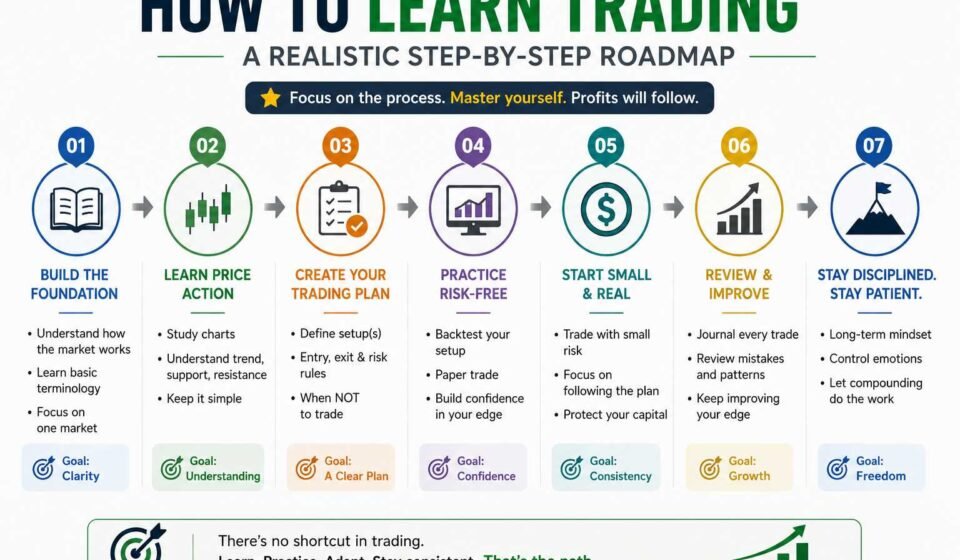

Most people learn trading in the wrong order. They start with a strategy video, then another strategy video, then a paid course promising a “secret indicator,” and only much later, usually after losing real money, do they learn the two things that actually mattered from day one: risk management and their own behaviour under pressure.
This post lays out the order that actually works, based on what tends to separate traders who become consistent from traders who stay stuck for years.
Step 1: Learn what you are actually trading, before anything else
Before touching a chart or an indicator, you need to understand the basic mechanics: what a stock, an index, a future, and an option actually are, how the market opens and closes, what a lot size is, and how margin works. This sounds obvious, but a huge number of traders skip straight to strategy content without a solid grip on these fundamentals, and it shows up later as confusion about position sizing and risk that has nothing to do with strategy at all.
If you need this foundation, start with this complete guide to what trading actually is before moving further down this roadmap.
Step 2: Learn to read a chart before you learn to predict one
The order matters here too. Most beginners jump straight to “strategies” (a specific indicator combination, a specific pattern) before they can even read a plain candlestick chart. Learn what a candle actually represents, what a trend looks like, and what support and resistance mean, before layering any strategy on top. A strategy applied by someone who cannot read the underlying chart is just following rules blindly, and blind rule-following breaks down the moment the market does something the rule did not anticipate.
Step 3: Paper trade, but treat it seriously
Paper trading (simulated trading with no real money) is where most people either build a real foundation or waste months. The difference is whether you treat it seriously. Track every trade, write down why you took it, and review it weekly, exactly as you would with real money. Paper trading done casually, just clicking buttons to see what happens, teaches you almost nothing about the market and nothing at all about yourself.
What paper trading genuinely can teach you: whether your strategy has a real edge over enough trades, and whether you can follow your own rules when there is no real pressure yet. What it cannot teach you is what happens when real money changes the pressure, which is the entire subject of Step 5.
Step 4: Open an account and learn the mechanics of actually placing a trade
At some point, reading about trading has to turn into doing it. Opening a demat and trading account, understanding brokerage and taxes, and placing your first small real trades are mechanical skills that only come from doing them. See this step-by-step guide to starting trading in India for the practical side of this step.
Keep the size small here, deliberately. The goal of this step is not to make money yet. It is to get comfortable with the mechanics: how an order actually fills, what slippage feels like, how quickly a position can move against you.
Step 5: Learn what actually breaks most traders, which is not strategy
This is the step almost everyone skips, and it is the reason so many traders plateau for years despite knowing the technical material well. Once real money is involved, a whole new layer of the problem appears: fear that makes you exit too early, greed that makes you hold too long, and revenge trading after a loss that has nothing to do with your strategy and everything to do with how you are wired to respond to pressure.
You cannot learn this from a strategy course, because a strategy course was never designed to teach it. This is why “I know what to do and still do not do it” is one of the most common things traders eventually say, usually a year or two after they thought they had already finished learning.
“I understood the chart perfectly. I just could not make myself take the trade, and then I could not make myself exit the one I was already in.”
Step 6: Build a review habit, not just a trading habit
Traders who improve steadily almost always have one thing in common: they review their trades regularly, honestly, and specifically. Not “I lost money today,” but “I moved my stop loss at 11:40 because the position was down 1.2%, and that is the third time this month.” Vague reviews produce vague improvement. Specific reviews produce specific fixes.
Common mistakes people make while learning
- Jumping straight to strategy content. A specific indicator combination or entry pattern feels like the missing piece, so beginners search for it before understanding the basics it is supposed to sit on top of. This produces a trader who can execute a rule without understanding why it works, which falls apart the first time the market behaves differently than the rule assumed.
- Watching without doing. Hours of trading videos can create a false sense of progress. Watching someone else read a chart is not the same skill as reading one yourself under time pressure, and the gap between the two only shows up once real trades are involved.
- Skipping paper trading, or not taking it seriously. Some beginners skip it entirely and go straight to real money. Others do it so casually that it teaches them nothing. Either way, the useful information paper trading can give you about your own discipline gets lost.
- Increasing size before the process is proven. A few good weeks with small size often leads to a jump in size before the process has actually been tested across enough trades and enough different market conditions to know if it holds up.
- Treating a losing streak as proof the strategy is broken. Sometimes it is. Often it is a normal drawdown within a strategy that still works, and the real question is whether the rules were followed, not whether the strategy needs replacing.
How long this realistically takes
There is no fixed number that applies to everyone, and anyone promising a specific timeline is usually selling something. What is more useful is understanding which parts of this roadmap take longest. Steps 1 through 4 can often be covered in a few months of consistent effort. Step 5, the psychological and behavioural side, is usually the slowest, and for many traders it is still being worked on years into their trading career, not because they are bad learners but because it is a genuinely different kind of skill than reading a chart. For a fuller look at realistic timelines, see how long it actually takes to learn trading.
Where most people actually get stuck
I started trading in 2018, and I learned this order the hard way, backwards, the same way most people do. I spent years on Steps 1 through 4, and every teacher I found only covered exactly that: setups, indicators, chart patterns. Nobody was teaching Step 5. It took five to six years of real losses to understand that the missing piece was never another setup. It was decision-making under pressure. That is the entire reason Mindful Trading Hub and the ACE framework (Aware, Control, Execute) exist: to cover the part of learning to trade that almost nobody else actually teaches.
Frequently asked questions
What is the best way to learn trading as a complete beginner?
Follow the order in this roadmap rather than jumping straight to strategy content: understand the basics first, learn to read a chart, paper trade seriously, then move to small real trades. Skipping steps to get to “the strategy” faster is the most common mistake.
How much money do I need to start learning?
You can learn Steps 1 through 3 with no real money at all, using paper trading. When you move to Step 4, start with an amount small enough that a full loss would not meaningfully affect you, since the goal at that stage is learning the mechanics, not generating returns.
Can I learn trading from YouTube alone?
YouTube can teach the mechanical and technical side reasonably well. It struggles to teach the behavioural side, since that requires someone observing your specific patterns over real trades, which a video cannot do.
Do I need to learn technical analysis and fundamental analysis both?
For most short-term and intraday trading, technical analysis matters more day to day. Fundamental analysis matters more for longer-term positions. Either way, neither one replaces the need to learn Step 5, since even a perfect analysis does not execute itself. Traders often assume more analysis will eventually solve an execution problem, and it usually does not, because the two are different skills entirely.
The real point
Most people learn trading in exactly the wrong order: strategy first, psychology last, if ever. Reverse that emphasis and the whole process gets faster, not slower, because you stop wasting years relearning the same behavioural lesson through repeated losses.
Sahi tarteeb mein seekhoge, toh kam samay mein zyada aage badhoge.
Related reading:
- What Is a Trading Decision Coach? (And Why It Is Different From a Strategy Coach)
- Signs You Need a Trading Psychology Coach, Not Just Another Strategy Course
- Trading Psychology: The Complete Guide for Indian Traders
If you have already covered the technical side and keep hitting the same wall anyway, that wall is usually Step 5. I run a free live session twice a week for traders with two or more years of experience who know the setups but still cannot execute under pressure. Register for the next free session here.
I am Samir Dash, founder of Mindful Trading Hub. I work with experienced traders on live market decision-making. More about my story here.