

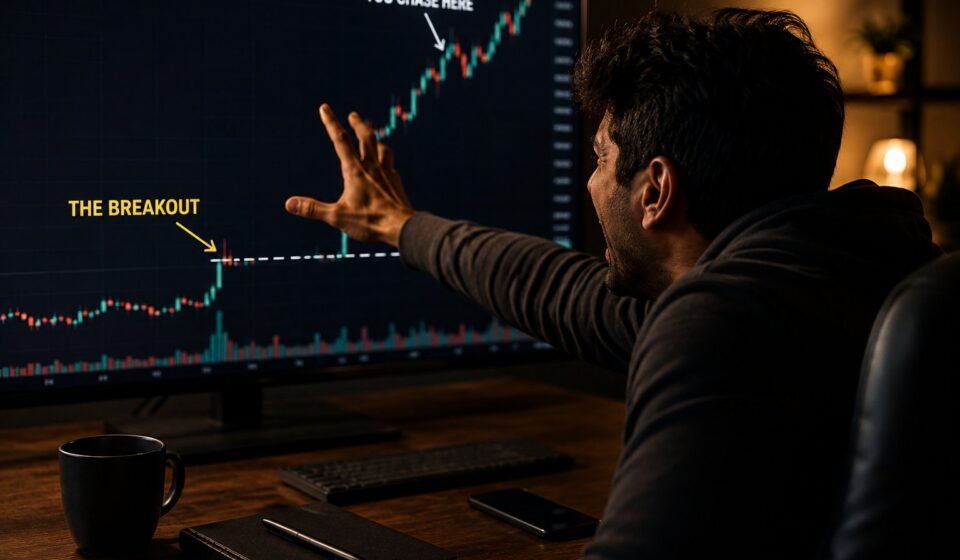

Chasing a breakout means entering a trade after the price has already made most of its move, driven by the fear of missing the rest of it rather than by a valid entry signal at that price. It is one of the most common ways traders give back an edge they otherwise have, because the setup was real, just no longer available at the price they entered.
What a real breakout entry looks like versus a chase
A planned breakout trade has a specific trigger level decided before the move happens, a stop placed just below that level, and a position size calculated against that stop. The entry happens at or very close to the trigger, because that is where the setup’s logic actually holds.
A chased entry happens after the price has already moved 2, 3, sometimes 5 percent past that trigger level. The trigger has already come and gone. What remains is the visual of a strong candle and the discomfort of watching it happen without being in it.
Why the urge to chase is so strong
The discomfort of watching a move happen without you is not really about the money you could have made. It is about the story your mind builds in real time: I saw this coming, I even had it on my watchlist, and I am about to miss it. That story creates urgency, and urgency is a poor substitute for a plan.
There is also a simple visual effect at work. A strong green candle looks like proof the move is real and will continue. But a candle that has already happened tells you what the price did, not what it will do next. By the time the move is visually obvious enough to trigger the fear of missing out, a meaningful part of the favourable risk-to-reward has usually already been used up by the traders who entered at the actual trigger.
“It’s still going, I can catch the second leg.”
That thought is doing the same job the revenge trader’s “I can make it back before lunch” does. It reframes an emotional decision as a rational one, right before the entry.
Why the entry price matters more than people think
Two traders can be right about the exact same stock, in the exact same direction, and have completely different outcomes because of where they entered.
Consider a stock that breaks out at ₹1,000 with a stop at ₹980, a risk of ₹20 per share. If the stock runs to ₹1,060, that trader made ₹60 against ₹20 of risk, a 3R gain. A trader who chases the move and enters at ₹1,040, using the same stop level at ₹980 because there is no other logical place to put it, is risking ₹60 to potentially make ₹20 to the same ₹1,060 target. The setup did not change. The entry price flipped the risk-to-reward ratio against the chaser entirely.
This is the part that gets lost in the moment. Chasing does not just mean a worse entry price. It usually means a fundamentally worse risk-to-reward trade, even when the direction call turns out to be completely correct.
The social version of chasing
Chasing often gets amplified by what you see other people doing. A trade already up 3 percent, with screenshots circulating in a trading group and comments about how strong it looks, creates the same urgency as watching the candle alone, except now it is backed by a crowd. The mechanics of this are covered in more depth in the social pressure of trading in a WhatsApp group, but the short version is that a crowd already in a trade makes staying out feel like the wrong decision, even when your own plan says otherwise.
Why chasing often ends in averaging down too
A chased entry frequently has an unfavourable risk-to-reward from the start, which means the stop is wider than it should be relative to the likely target. When the trade pulls back, as breakouts commonly do even when they eventually work, the chaser is more likely to hold through a drawdown that a properly sized trade would not have created, and more likely to add to the position on the pullback to improve the average price. This connects directly to the pattern covered in averaging down: why it feels smart and rarely is. One mistake in entry timing tends to create the conditions for a second mistake in position sizing.
What actually helps
Define your trigger level before the session, not during it
Write the exact price that would validate the breakout before the market opens. If the price has already moved past that level with meaningful distance by the time you notice it, the trade is missed for today, not delayed.
Use a maximum chase distance, and make it small
Some traders build a rule allowing entry up to a small, fixed percentage beyond the trigger level, recalculating the stop and size accordingly. This is different from chasing without a rule, because the risk-to-reward is checked before entry rather than assumed to still be fine.
Let the risk-to-reward decide, not the emotion
Before every late entry, calculate the actual risk-to-reward from the current price to your stop and your realistic target. If it no longer meets your minimum bar, usually at least 1.5 to 2 times the risk, the trade is not the same trade anymore, regardless of how correct the original setup was.
Keep a “missed trades” log instead of chasing
Write down setups you missed, including what would have happened if you had waited for the next similar setup versus chasing this one. Most traders find, after a few months of honest tracking, that waiting for the next clean setup outperforms chasing the current one, because chased entries carry worse risk-to-reward on average even when the direction is right.
Building patience for the next setup
Part of what makes chasing so persistent is that it feels like the only option in the moment, since the missed trade is right there on the screen and the next one has not appeared yet. Building genuine patience for the next setup usually comes down to trusting that another one will, in fact, appear, and that trust is built through evidence, not through willpower alone.
A practical way to build that evidence is to count, over a full month, how many valid setups matching your criteria actually appeared across your watchlist, not just the one you chased. Most active traders who do this are surprised by the number. Markets that produce one memorable breakout on a given day are usually producing several other valid setups the same week, simply less visible because they did not come with the same dramatic candle.
Once that count exists, the chased trade stops looking like a scarce, once-a-month opportunity and starts looking like one instance of something that happens regularly. That shift in framing, from scarcity to regularity, is often what finally makes it possible to let a missed trade go without acting on the fear that it was the only one available.
Frequently asked questions
Is it ever okay to enter a breakout late?
Yes, if the risk-to-reward from the current price still meets your minimum bar and you recalculate your stop and size for the actual entry price rather than reusing the original plan. The problem is entering without recalculating anything.
Why do I feel worse missing a trade than losing on one?
A miss carries an open-ended story about what could have been, while a loss has a defined, closed number attached to it. The open-ended story tends to feel worse because there is no natural end point to stop imagining it.
How far past the trigger is too far to enter?
There is no universal number, but a common approach is capping it at a small fraction of your usual stop distance, so a chased entry never more than roughly doubles your intended risk on that setup.
Does chasing ever work?
Individual chased trades can and do win, which is part of why the habit persists. Judged across many instances, chased entries tend to show a worse average risk-to-reward than planned entries on the same setups, even when win rate looks similar.
How do I stop watching the screen for FOMO trades?
Set your trigger alerts in advance so you are notified only at your planned level, rather than watching the chart continuously, which is what generates the emotional pull to act on a move that has already happened.
The real point
A breakout is a specific price behaviour at a specific level. Once the price has moved well past that level, you are no longer looking at the same trade, even if the ticker symbol is identical. Chasing is choosing the story of the move over the arithmetic of the entry.
The market does not reward better predictions. It rewards better decisions.
Jo nikal gaya, woh nikal gaya. Agla setup aayega.
Related reading:
- Revenge Trading: Why You Keep Trying to Win It Back
- When to Exit a Trade: The Decision Framework Most Traders Skip
- Overtrading: The Habit That Quietly Empties Accounts
Want to break this loop properly? I run a free live session twice a week for traders with two or more years of experience who know the setups but still cannot execute under pressure. Register for the next free session here.
I am Samir Dash, founder of Mindful Trading Hub. I work with experienced traders on live market decision-making. More about my story here.