

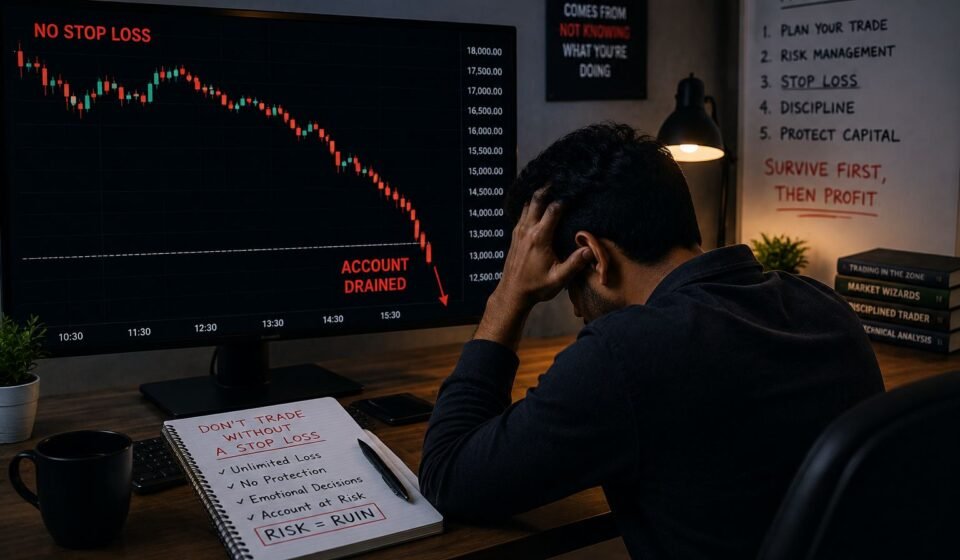

There is a version of this argument that sounds sophisticated, and you have probably heard it.
“Stops are for people who cannot handle drawdown. Institutions do not use retail stop losses. My stops just get hunted anyway. I use a mental stop and exit when the thesis is invalidated.”
Parts of that are true. The conclusion is still wrong for almost everyone reading it, and this post is about exactly why, in numbers rather than lecture.
Why it feels like it is working
Start with the honest part, because this is what makes the habit so sticky.
Trading without a stop loss increases your win rate. Genuinely. This is not an illusion.
Without a stop, a trade only closes when you decide to close it. Many positions that would have stopped out will eventually come back to breakeven or better if you hold long enough. So your percentage of winning trades goes up, sometimes dramatically. Traders running no stops routinely report 80% or 90% win rates.
They are not lying. That is what the strategy produces.
And because win rate is the number most traders check first, the feedback looks excellent for weeks or months. Nine green trades, one open position that is “temporarily” underwater.
The arithmetic underneath
Here is what the win rate is hiding.
Take a trader with a 90% win rate and no stops. Wins average 0.5R, because without a stop you tend to close winners quickly to bank the certainty. The 10% that do not come back run until they are closed in panic, averaging 8R.
Over 100 trades:
- 90 wins × 0.5R = +45R
- 10 losses × 8R = -80R
- Net: -35R
A 90% win rate, and the account is down badly.
Now compare the same trader with a 1R stop. The win rate collapses to 40%, which feels much worse. Winners run to 3R because a defined stop lets you hold with a known worst case.
- 40 wins × 3R = +120R
- 60 losses × 1R = -60R
- Net: +60R
Worse win rate. Vastly better outcome. This is the trade-off the no-stop approach inverts, and it inverts it in the direction that feels best while performing worst.
The real problem: your worst loss is undefined
The arithmetic above assumes the bad trades average 8R. In practice there is no ceiling at all, and that is the actual danger.
With a stop, your maximum loss per trade is a known number decided in advance. Without one, your maximum loss is determined by two things you cannot control: how far price moves, and how long you can tolerate watching it.
The second variable is the one that ends accounts. You do not exit at a planned level. You exit when the discomfort becomes unbearable, which is a function of your emotional state, not of the market. And that threshold is usually reached near the point of maximum pain, which is frequently close to the reversal.
This is the documented Indian pattern. The Bengaluru trader who lost ₹45,000 on BankNifty options in two weeks did not lose it through many small controlled losses. Positions were held, then size was increased to recover.
One trade with no defined exit can undo a year of correct trading. It does not need to happen often. It needs to happen once.
Answering the arguments
“Institutions do not use stop losses”
Some do not use resting stop orders, which is a different claim. They have defined risk limits, mandated position sizing, risk managers who close positions independently of the trader’s opinion, and hedging instruments you do not have access to. Their risk control is more rigorous than yours, not less. Copying the surface behaviour while skipping the infrastructure is not the same trade.
“My stops just get hunted”
Stop runs are real. They are also not personal, and the response is placement, not removal. If your stop is being taken by ordinary noise, it is inside the noise range. Measure ATR and place the stop beyond your invalidation level with a real buffer, then size down to keep the rupee risk constant. Removing the stop replaces a solvable placement problem with an unbounded one.
“I use a mental stop”
A mental stop is not a stop. It is a plan to make a decision later, and later is exactly when you will be least able to. The entire function of a stop is to move the exit out of the live moment. A mental stop leaves it precisely where the problem lives.
Test it honestly against your own records: in the last ten trades where price hit your mental stop level, how many did you actually close there? Most traders find the answer is under half.
“I only trade with money I can afford to lose”
Then the position sizing should reflect that, and the stop costs you nothing. This argument is usually made in advance and abandoned once the position is real, because an unrealised loss creates pressure regardless of what you told yourself earlier.
“I hedge instead”
Legitimate if it is planned before entry with defined total risk. Hedging a losing position after the fact, by buying the opposite side to stop the bleeding, is not risk management. It locks in the loss with extra brokerage and creates two positions to be wrong about.
What to do if stops keep hitting
The frustration is real and the solutions are not “try harder.”
- Measure your stop distance against ATR. If your typical stop is under one ATR on your timeframe, ordinary movement is taking you out. This is the most common cause by a wide margin.
- Move the stop beyond obvious levels. Round numbers and exact swing points collect orders. Go past them with a buffer.
- Widen the stop and cut the size. Same rupee risk, far more room. Most traders resist this because smaller size feels like going backwards. It is the fastest fix available.
- Use candle-close stops. Exit only if a candle closes beyond your level, rather than on a wick. Slightly worse fills, far fewer spike exits.
- Consider a longer timeframe. If noise on the 5-minute chart keeps taking you out, the 15-minute may suit your temperament better. This is a legitimate structural fix.
Every one of these keeps the exit mechanical. That is the property worth protecting.
The one honest exception
There is a case where trading without a stop-loss order is defensible: a position whose maximum loss is already fixed by the instrument.
A long option has a defined maximum loss, the premium paid. If you sized the position so that losing the entire premium is inside your risk limit, you have a defined worst case without a stop order. The risk was capped at entry by structure rather than by an order.
The conditions are strict, and they are the whole point. The premium must be inside your normal per-trade risk, you must be genuinely willing to lose all of it, and you must not add to the position to average down.
This does not extend to selling options, futures, or equity, where the loss is not bounded. Short options in particular have the opposite profile: high win rate, undefined loss, which is the exact shape this article warns about.
Frequently asked questions
Is a stop loss compulsory for intraday trading?
Not by regulation in most cases, though many brokers auto-square-off intraday positions near market close, which acts as a crude time-based exit. Relying on that is not risk management, since the square-off happens at whatever price exists at that moment.
Do stop losses reduce profits?
They reduce win rate and increase average win size, because a defined worst case lets you hold winners longer. Net effect on profitability is strongly positive for almost every retail system.
What about long-term investing? Stops are not used there.
Correct, and that is a different activity with a different thesis, different time horizon, and no leverage. This article is about trading, particularly leveraged F&O trading, where an undefined loss compounds against you quickly.
I have traded without stops for months and I am fine.
That is exactly what the arithmetic predicts. This approach produces long stretches of positive results followed by one loss that removes them. The absence of the event so far is not evidence it will not happen. Check your largest open drawdown rather than your win rate.
The bottom line
Trading without a stop loss gives you a better win rate, a better feeling, and a worse account. It works until the trade that does not come back, and that trade is not rare, it is just not yet.
You cannot control whether a trade goes against you. A stop is how you decide in advance what that is allowed to cost.
Bina stop loss ke aap trade nahi kar rahe. Aap umeed kar rahe hain.
Related reading:
- Risk Management Rules That Actually Get Followed
- When to Exit a Trade: The Decision Framework Most Traders Skip
- The ACE Framework: Aware, Control, Execute Explained
Want to fix stop placement properly? I run a free live session twice a week for traders with two or more years of experience who know the setups but still cannot execute under pressure. Register for the next free session here.
I am Samir Dash, founder of Mindful Trading Hub. I work with experienced traders on live market decision-making. More about my story here.