

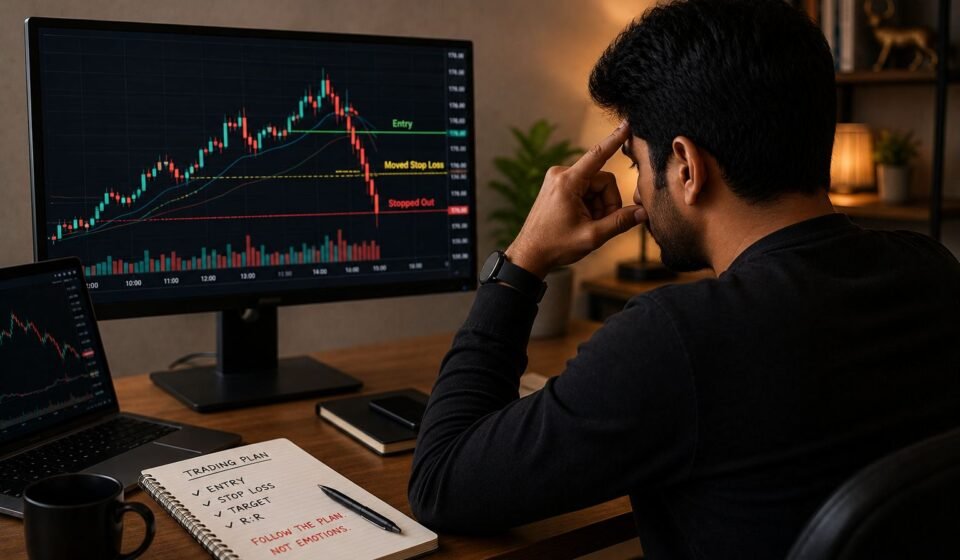

You set the stop when you entered. Price approached it. You widened it by twenty points because the level “was not quite right.”
Price took the new stop too.
This is the single most expensive habit in retail trading, and it is worth being precise about why. It is not that moving a stop is a large error. It is that it converts a known, planned, survivable loss into an unknown one. As a trader on an Indian forum put it, this is how “a small loss may be converted to the mother of all losses.”
The moment it happens
Nobody moves a stop while calm. It happens in a specific, recognisable moment, and the moment has a shape.
Price is approaching your stop. You are watching it tick. And a thought arrives that is not “I want to avoid this loss.” It is something far more respectable:
- “That is obviously a liquidity grab, it will reverse right after.”
- “My stop is two points inside the level, I placed it badly.”
- “There is news in ten minutes, let it breathe until then.”
- “The daily timeframe is still clearly bullish.”
Every one of those is a technical argument. Some are occasionally correct. That is exactly what makes this hard, and it is why “have more discipline” does not work as advice.
Here is the test that cuts through all of it, and it is the only one you need:
Would this argument have occurred to me if I were flat?
If you had no position on, would you be looking at that chart thinking about liquidity grabs at that specific level? Almost always the answer is no. The analysis is real, but it was generated by the position, not by the chart.
Why your brain does this
Two mechanisms, and understanding them tells you where the fix has to go.
An unrealised loss is not yet a loss. This is the core of it. While the position is open, the outcome is undecided. The moment your stop fills, it becomes fact. Moving the stop is not really about the money. It is about postponing the moment the loss becomes real.
You are not trying to make money on that trade any more. You are trying to not have lost yet. Those are different goals and only one of them is trading.
Losses weigh about twice what equivalent gains do. Losing ₹5,000 does not feel like the opposite of winning ₹5,000. It feels heavier and it lasts longer. So the pressure to avoid realising it is roughly double the pressure you would feel to capture the same gain.
This is also why the stop gets moved a second time. The mechanism does not resolve. It escalates, because the loss you are now avoiding is larger.
The arithmetic of one moved stop
Concrete numbers, because the abstract version does not land.
Your system: 40% win rate, 3R winners, 1R losers. Over 100 trades that is +60R. A good system.
Now move your stop on just one trade in ten. Assume a moved stop averages a 2.5R loss instead of 1R, which is conservative, since moved stops frequently run much further.
- 40 wins × 3R = +120R
- 54 normal losses × 1R = -54R
- 6 moved-stop losses × 2.5R = -15R
- Net: +51R
You lost 9R, about 15% of your annual return, by breaking a rule on six trades out of a hundred.
Now make it one in five, and assume the moved stops average 4R because you are further into the habit:
- 40 wins × 3R = +120R
- 40 normal losses × 1R = -40R
- 20 moved-stop losses × 4R = -80R
- Net: 0R
Same entries. Same win rate. Same analysis. Break-even instead of excellent, and the strategy is not what changed.
The rule that fixes it
Everything else in this post is context. This is the actual fix, and it is one sentence.
Place the stop as a live order at entry, and never widen it. It may move toward your entry. It may never move away from it.
Two components, and both matter.
As a live order at entry. Not a mental stop. Not an alert. A resting stop-loss order sitting with your broker from the moment the position opens. A mental stop is not a stop, it is a plan to make a decision later, at the exact moment you will be least equipped to make it.
One direction only. Moving a stop to reduce risk is fine. Moving it to increase risk is the behaviour. Stating it as a direction rule makes it unambiguous in the moment, when you will otherwise find a reason why this case is different.
The rule works because it removes the decision from the moment rather than trying to win the argument during it. You will lose that argument, because the part of you making the case is smart, motivated, and has a chart open.
Four supports that make it hold
1. Size so the full stop does not matter much
This is the real reason people move stops, underneath everything else. If your stop loss hurts, you will move it. If the loss is genuinely survivable, the pressure drops enough for the rule to hold.
Cap single-trade risk at a third of your daily loss limit. If you have been moving stops regularly, halve your size for two weeks. The behaviour usually stops on its own, which tells you it was a sizing problem wearing a discipline costume.
2. Place the stop where the idea is wrong, not where the loss is comfortable
The stop belongs at the price that proves your reason for entering was incorrect. Beyond the structure, beyond the level, past the invalidation point.
If that stop is too wide to accept, the answer is a smaller position, not a closer stop. A stop placed at a comfortable distance rather than a meaningful one will get hit by noise, and getting hit by noise repeatedly is what convinces traders that stops do not work.
3. Leave the screen once the stop is live
You cannot move a stop you are not watching. Set the entry, set the stop, set the target, and step away until your defined checkpoint.
Watching every tick is what generates the arguments. Reduce the number of times you look and you reduce the number of chances to interfere.
4. Log every instance
One line: date, whether you moved it, and what the final loss was versus the original stop.
After a month, add up the difference. That number is what this habit costs you, in rupees, and it is usually the single most persuasive thing a trader can look at.
Frequently asked questions
Is it ever correct to widen a stop?
Only if the widening was defined before entry as part of the plan, for example a pre-planned volatility expansion around a known news release, with total risk still inside your limit. If you decided during the trade, it is not a plan, it is this article’s behaviour.
What if the market really does hunt stops?
Stop runs are real. They are also not personal, and they are not a reason to remove your stop. They are a reason to place it beyond obvious clusters, which is a placement decision made before entry. See Stop Loss Hunting: Is the Market Really Targeting You?
I use a mental stop because my broker’s stops get triggered by spikes.
This is the most common justification and it usually costs more than the problem it solves. If spike triggers are genuinely an issue, use a wider stop with a smaller position, or a stop based on candle closes. Both keep the exit mechanical. A mental stop moves the decision into the worst possible moment.
I moved my stop and the trade recovered into profit. Was that wrong?
Yes, and this is the most dangerous outcome available. A rule break that gets rewarded is far more expensive than one that gets punished, because it teaches you the sequence works. Judge the behaviour across fifty instances, not the one you remember.
How long before this stops feeling hard?
Most traders see the urge drop off within three to four weeks of a live stop order plus reduced size. What takes longer is the discomfort of watching a stop fill without doing anything. That does not disappear entirely, and it does not need to. The rule holds anyway.
The bottom line
A stop loss is a decision you already made. Moving it means letting the least reliable version of you overrule the most reliable version, using arguments the position generated on its own behalf.
Place it live at entry. Move it only toward your entry. Everything else is negotiation.
Stop loss aapki galti nahi hai. Use hataana galti hai.
Related reading:
- Risk Management Rules That Actually Get Followed
- When to Exit a Trade: The Decision Framework Most Traders Skip
- The ACE Framework: Aware, Control, Execute Explained
- How to Place a Stop Loss You Will Not Move
- Stop Loss Hunting: Is the Market Really Targeting You?
- How to Set a Stop Loss in F&O Trading
Struggling to hold your stops? I run a free live session twice a week for traders with two or more years of experience who know the setups but still cannot execute under pressure. Register for the next free session here.
I am Samir Dash, founder of Mindful Trading Hub. I work with experienced traders on live market decision-making. More about my story here.