

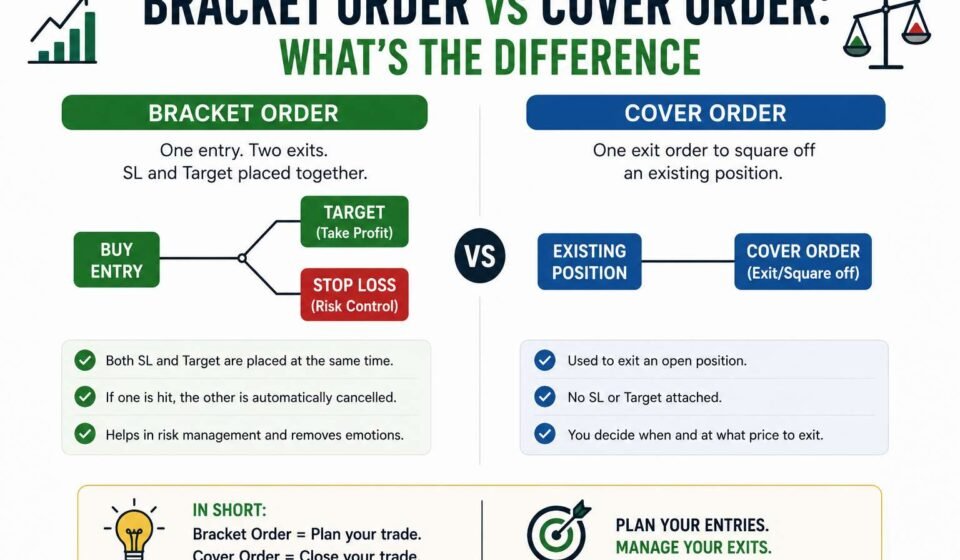

A bracket order and a cover order are both special intraday order types that attach a stop loss automatically, but a bracket order also attaches a target and lets you trail your stop, while a cover order only attaches the stop loss and nothing else. That one-line difference decides almost everything else about when a trader reaches for one over the other. This post breaks down exactly how each one works, what actually happens on your screen and in your margin, and which situations call for which.
Why these order types exist in the first place
Placing a regular intraday order means you, personally, have to remember to place a separate stop loss order right after your entry fills, and remember to cancel it if you exit manually. In a fast-moving market, that gap between entry and stop placement is exactly where things go wrong: a distraction, a slow click, or a frozen screen can leave a position completely unprotected for a few critical seconds. Bracket orders and cover orders solve this by forcing the stop loss to be placed at the same time as the entry, as a single, linked order. The broker will not let the entry go through without it.
What a cover order actually is
A cover order is the simpler of the two. You place your entry order, buy or sell, and along with it you are required to place a compulsory stop loss order. That is the entire structure: an entry, plus one linked stop loss. There is no target attached and no separate trailing mechanism built into the order itself. Once your entry fills, the stop loss sits live in the market, and you manage the exit on profit manually, by closing the position yourself whenever you decide to book it.
The main reason traders use cover orders is margin. Because the stop loss is compulsory and known in advance, the broker’s risk on the position is capped, and cover orders typically come with higher intraday leverage than a plain, unprotected intraday order would get. For a trader who wants simple, high-leverage intraday exposure with a hard stop loss and no interest in an automated target, a cover order is a clean fit.
What a bracket order actually is
A bracket order takes the same core idea, entry plus compulsory stop loss, and adds a third piece: a target order, placed at the same time as the entry. Once your entry fills, both the stop loss and the target are live simultaneously. Whichever one gets hit first executes, and the other one is automatically cancelled. This is where the name comes from: the entry price sits “bracketed” between a stop loss below and a target above, for a long position, or the reverse for a short one.
Many bracket order implementations also let you attach a trailing stop loss, so as the trade moves in your favor, the stop loss automatically moves up behind it, locking in a growing amount of profit without you having to manually adjust anything. This turns a bracket order into something closer to a small, fully automated trade plan: entry, stop, target, and an evolving trail, all placed in one shot.
The core structural difference, side by side
A cover order gives you an entry and a stop loss. A bracket order gives you an entry, a stop loss, and a target, with optional trailing built in. That extra structure is the entire difference, and it shapes everything downstream, how automated the trade is, how much you need to babysit it, and in some cases, the margin you get.
When a cover order fits better
A cover order suits a trader who wants a hard, mandatory stop loss for discipline and higher intraday leverage, but who prefers to make the exit-on-profit decision themselves rather than pre-committing to a fixed target. If your approach involves reading price action live and deciding in real time when a move has run its course, forcing a fixed target into the order does not fit how you actually trade. A cover order gives you the protection without locking in an exit level you might want to override.
When a bracket order fits better
A bracket order suits a trader who already knows, before entering, exactly where they would take profit and exactly where they would cut the loss, and who wants that entire plan executed without needing to sit and watch the position tick by tick. If you have a defined setup with a calculated risk-reward ratio worked out in advance, a bracket order turns that plan into something the system enforces for you, which removes the moment-to-moment temptation to move your stop or second-guess your target while the trade is live.
A practical way to decide between the two
Ask yourself one question before you place the order: do I already know my exit-on-profit level right now, or do I want to decide that later based on how the trade develops. If you already know it, a bracket order lets the system hold you to your own plan. If you genuinely need to watch the trade play out before deciding where to book profit, a cover order gives you the mandatory stop loss without forcing a target you have not actually decided on yet.
What both order types have in common
Both are intraday-only order types on most platforms, meaning open positions under either one are typically squared off automatically before the market closes if you have not exited already. Both require the stop loss to be placed compulsorily, which removes the single most common way undisciplined traders get hurt, forgetting or delaying a stop loss after entry. And both are still only as good as the levels you choose. Neither order type picks a sensible stop loss or target for you. That judgment call remains entirely yours, which ties directly into risk management rules that actually get followed, since an order type can enforce that a stop exists, but it cannot enforce that the stop is a sensible one.
A common mistake with both
Traders sometimes place a bracket or cover order with a stop loss set far too tight, purely to satisfy the mandatory requirement, without genuinely thinking through where the trade idea would actually be proven wrong. A stop loss that is too close gets hit by ordinary market noise rather than a real reversal, and a trader who does this repeatedly can end up with a string of small, avoidable losses that have nothing to do with their actual trade idea being wrong. The order type enforces that a stop exists. It does not protect you from placing a bad one.
How trailing changes a bracket order
When you attach a trailing stop loss to a bracket order, the stop moves in your favor by a fixed amount as the price moves in your favor, but it never moves backward against you. This means a trade that starts moving well can lock in an increasing amount of profit automatically, even if you are away from your screen. It is worth understanding this mechanism specifically, covered in more depth in trailing stop loss: the discipline nobody wants to follow, since a trailing stop that is set too tight can exit a genuinely good trade on ordinary volatility, the same way an overly tight fixed stop loss can.
Margin and leverage considerations
Because both order types come with a mandatory, known stop loss, brokers are generally willing to offer higher intraday leverage on them compared to a plain intraday order without one. The exact leverage multiples vary by broker and by instrument, and change over time, so treat any specific figure you see quoted elsewhere as something to verify directly with your own broker rather than a fixed universal number. What stays constant is the underlying logic: a known, capped risk lets the broker extend more buying power, which is exactly why these order types exist as a distinct category rather than just being a convenience feature. This additional leverage is also a reason to be extra deliberate about position sizing, since higher leverage magnifies both gains and losses.
Frequently asked questions
Can I modify the stop loss after placing a bracket or cover order?
Most platforms allow you to modify the stop loss and, for bracket orders, the target, after the order is placed, as long as the position is still open. The specific modification rules and any restrictions depend on your broker’s platform.
What happens if neither the stop loss nor the target is hit by market close?
Since these are intraday order types, the position is typically squared off automatically at or before the exchange-mandated intraday cutoff, regardless of whether your stop loss or target has been hit.
Is a bracket order better than a cover order?
Neither is universally better. A bracket order suits a trader with a fully defined plan who wants it automated end to end. A cover order suits a trader who wants a mandatory stop loss and higher leverage without committing to a fixed target in advance.
Do bracket and cover orders work for both buying and selling?
Yes, both can typically be used for long positions and short positions, with the stop loss and target, where applicable, placed on the appropriate side of the entry price for the direction of the trade.
Can I use a bracket or cover order for delivery trades, not just intraday?
These order types are generally designed for intraday trading specifically, because the mandatory stop loss and elevated leverage are tied to the position being closed within the same trading session. Check your specific broker’s platform for exactly which order types are available for delivery trades.
The bottom line
A cover order is an entry plus a mandatory stop loss. A bracket order is an entry plus a mandatory stop loss plus a target, with optional trailing. Choosing between them comes down to one honest question: do you already know where you would book profit, or not. Whichever one you use, the order type only enforces that a stop exists. Placing a sensible one is still your job.
Order type se stop loss lagana automatic ho jaata hai, lekin sahi jagah stop lagana aaj bhi tumhara hi kaam hai.
Related reading:
- What Is Margin Trading? Meaning, Risks and How It Works
- Position Sizing: The Fix for Most of Your Emotional Trades
Want to learn this from the source? I run a free live session twice a week for traders with two or more years of experience who know the setups but still cannot execute under pressure. Register for the next free session here.
I am Samir Dash, founder of Mindful Trading Hub. I work with experienced traders on live market decision-making. More about my story here.