

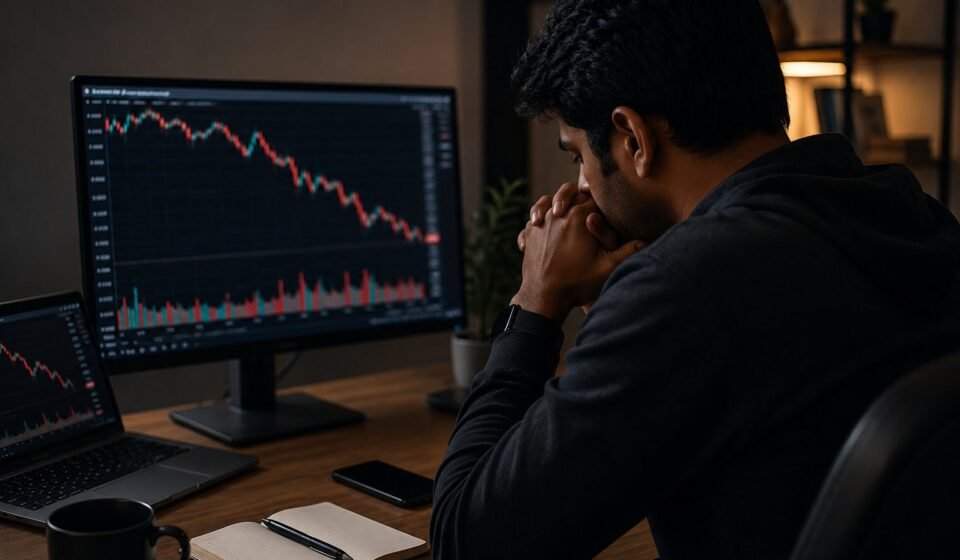

The losing trade is not the expensive part. It was 1R, it was planned for, and your system already accounts for it.
The expensive part is the next 20 minutes.
That window is where a normal 1R loss turns into a 6R day. Most traders have no routine for it at all, which means the window gets filled by whatever the impulse suggests. This post gives you something to put there instead.
Why 20 minutes specifically
Two things are happening in that window.
First, the open loop. A realised loss gets filed by your brain as an unfinished task, and unfinished tasks generate pressure to close them. The market is still open and your capital is still there, so closing it looks available. The recovery thought arrives roughly 90 seconds in and it sounds completely reasonable: “the market is still trending, I can make this back.”
Second, the setup that tempts you is time-limited. The move you want to chase is happening now. In 20 minutes it will have either played out or died, and either way it will not be there to chase.
That is the whole mechanism the routine exploits. The urge is intense and short. You do not have to beat it. You have to outlast it.
The routine
Six steps. The order matters, and the first one is not optional.
Minute 0: Stand up and leave the screen
Physically. Not minimise the window, not “just watch for a minute.” Leave.
Set a 20-minute timer on your phone before you go. A timer in your head is not a timer, it is an intention, and intentions negotiate.
This single step does more than the other five combined, because every other failure in this window requires you to be at the screen.
Minutes 1 to 3: Say the number out loud
“I am down ₹6,400 today.”
This sounds trivial and it is doing real work. A loss you avoid looking at grows in your imagination while staying the same size in your account. Naming it directly is uncomfortable for about 30 seconds, and then it stops expanding.
Most traders who blow up a day never once state the actual figure until after the market closes.
Minutes 3 to 8: Answer one question in writing
Not a full journal entry. One question:
Was this a bad trade, or a good trade that lost?
These are different events and they need different responses, and separating them is the most valuable habit in this entire routine.
A good trade that lost followed your plan. Correct setup, correct size, stop where it belonged. Nothing to fix. Your system produces these at a known rate and this one is already priced in.
A bad trade broke a rule. Wrong size, no defined stop, a setup that was not on your list, entered at the wrong time.
Write one sentence for whichever it was. If it was a bad trade, name the specific rule you broke, not a general feeling. “I entered before the candle closed” is useful. “I was impatient” is not.
Minutes 8 to 15: Check your state, not the chart
Three questions. Answer honestly, in writing, with a number where possible.
- How many hours did I sleep?
- Is there money pressure on me from outside the market right now?
- Is the urge to trade right now stronger than it was before this loss?
That third question is the one that matters. If the answer is yes, you are in the sequence, and everything you do for the rest of the session should be treated as suspect.
Two of three answering badly means half size for the rest of the day, or done for the day.
Minutes 15 to 20: Re-read your plan
Your actual written plan. Setups you take, size, daily loss limit, stopping rule.
The purpose is not information, you already know what it says. The purpose is to re-anchor to the version of you that wrote it, who had no position on and nothing to recover.
Minute 20: Decide, once
One of three, said out loud:
- Back in at normal size, only on a setup already on my list. Available only if the loss was a good trade that lost and your state check was clean.
- Back in at half size for the rest of the session. The right answer if the state check was mixed.
- Done for the day. Terminal closed.
Mandatory: if this was your second consecutive full stop-out, the answer is 3. That is not a judgment call, it is the two-strike rule, and the whole reason it is a rule is that you are not currently in a position to judge.
What not to do in this window
Do not analyse the chart you just lost on. You will find a reason it should have worked, and that reason will become the justification for re-entry. There is always one available.
Do not check other instruments. Nifty stopped you out, so Bank Nifty looks interesting. You have no plan and no data there. This is the same trade wearing a different name.
Do not calculate what you need to get back to flat. The moment you know that number, it becomes a target, and targets get pursued with size.
Do not open social media. You will find someone posting a winning screenshot from the exact move you just lost on.
Do not decide to “just watch.” Nobody in the history of trading has just watched.
Making it stick
A routine you have to remember while agitated is not a routine.
Write these six steps on a card and physically place it next to your screen. Not a note on your phone, a card you cannot scroll past. The whole reason it works is that it is visible at the exact moment you would otherwise be clicking.
Then log it. One line per instance: date, what the loss was, which of the three decisions you took, and what you actually did. After two weeks you will be able to see your own compliance rate, and after a month you will know your danger window precisely. For most traders it turns out to be remarkably narrow, often the same 30-minute stretch of the same part of the day.
Once you can name your window, you can defend it.
Frequently asked questions
Twenty minutes is a long time. Will I not miss good setups?
You will miss some, and that is the price. A missed setup costs you nothing from your account. One revenge sequence can cost two weeks of gains. You are not trying to catch every trade, you are trying to still be trading next year.
What if the loss was tiny?
Scale it. A small loss inside your normal range does not need the full routine, just the state check. Run all six steps when the loss hit your full stop, or when you notice the urge to re-enter immediately. The urge is the trigger, not the rupee amount.
Can I do this routine at the screen instead of leaving?
You can, and it works far less well. Every failure mode in this window requires proximity to the order window. The physical separation is not ceremony, it is the mechanism.
What if I am on a losing streak across several days?
Different problem, different post. A single bad session is handled here. Several bad sessions in a row raise a separate question, which is whether this is a normal drawdown or your strategy has stopped working. See Is It a Drawdown or Is Your Strategy Broken?
The point
You cannot control whether a trade loses. You have complete control over what happens in the 20 minutes afterwards, and that window costs more than the trade did.
Fill it with a routine and it stops being the most expensive part of your day.
Ek trade aapka din kharab nahi karti. Uske baad ka reaction karta hai.
Related reading:
- Fear of Loss in Trading: Why You Cannot Pull the Trigger
- Averaging Down: Why It Feels Smart and Rarely Is
- What Happens in Your Brain While a Trade Is Open
Want a routine built for how you actually trade? I run a free live session twice a week for traders with two or more years of experience who know the setups but still cannot execute under pressure. Register for the next free session here.
I am Samir Dash, founder of Mindful Trading Hub. I work with experienced traders on live market decision-making. More about my story here.