
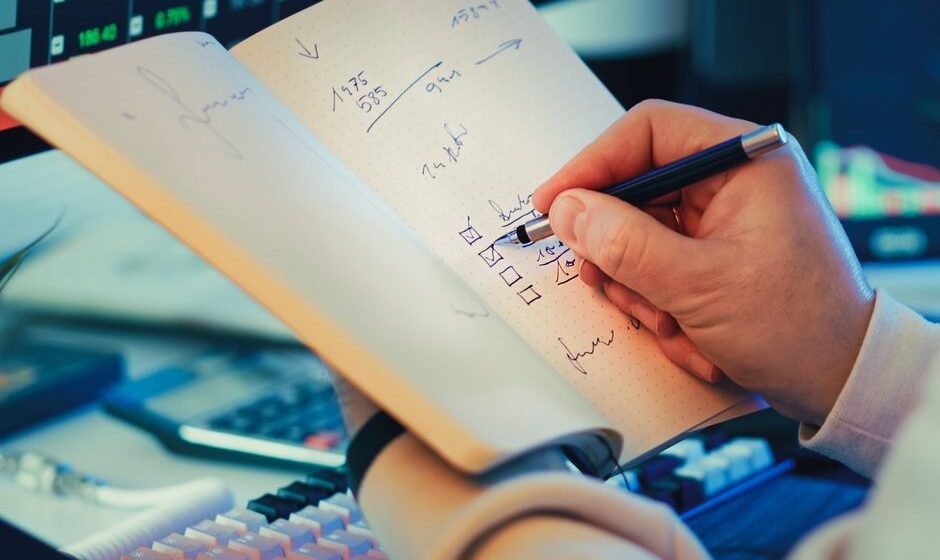

Meditation for traders is a short, daily practice of sitting still and training your attention on one thing, usually your breath, so that noticing your own state becomes easier during a live trading session.
This is the pillar post on meditation for traders. It covers exactly how to start, how long to sit, what actually happens during the practice, and how it connects to the decisions you make with real money. If you want to understand the broader skill this practice builds, see Mindfulness for Traders.
What meditation actually trains
Meditation is not about clearing your mind or feeling peaceful. Thoughts will keep showing up the entire time you sit, for as long as you practice, even after years. What meditation trains is something more specific: the moment of noticing that your attention has wandered, and the act of bringing it back.
That exact motion, noticing you have drifted and returning, is the same motion you need during a live trade when you notice your attention has drifted from your plan to your fear, or from the current candle to your P&L target. Meditation is where you practice that motion in a low-stakes setting, ten minutes with no money on the line, so it is available to you in a high-stakes one.
Why 10 minutes is enough to start
Most traders who never start meditating assume it requires 30 to 60 minutes a day, which feels impossible to fit around a trading schedule. It does not. Ten minutes a day, done consistently, builds the underlying skill more effectively than sixty minutes done twice a week and then abandoned.
The reason is simple. This is a skill built through repetition, not duration. Sitting for ten minutes gives you many small repetitions of noticing and returning within that window. Consistency across weeks matters more than length on any single day.
How to actually do it: a simple starting method
You do not need an app, a cushion, or a special room. You need a chair, a quiet ten minutes, and this sequence.
- Sit upright, feet flat on the floor, hands resting on your knees or in your lap. Close your eyes, or if that feels uncomfortable, keep a soft, unfocused gaze at a point on the floor.
- Bring your attention to your breath, wherever you feel it most clearly, usually the nostrils or the rise and fall of your chest. Do not try to change your breathing, just notice it as it already is.
- Your mind will wander. This is not a failure, it is the practice itself. When you notice it has wandered, gently bring your attention back to the breath, without criticising yourself for drifting.
- Repeat step 3 for the full ten minutes. You may notice your attention wander thirty times in ten minutes when you start. That is completely normal and not a sign you are doing it wrong.
- End by opening your eyes and sitting for a few seconds before moving, rather than jumping straight into your phone or the market.
A simple timer on your phone is all you need. No app is required, though a basic meditation timer app can help if you find counting distracting.
The best time to practice as a trader
Two windows work particularly well for traders, and they train different things.
- Before the market opens, around 9:00 to 9:10 am. This sets your baseline state for the day and gives you a clear reference point for “calm” that you can compare against later, when the session gets stressful.
- After the market closes, around 3:30 to 4:00 pm. This helps process the day’s ups and downs before they carry into your evening, and builds the noticing skill on a fresh mind rather than a tired one.
If you can only manage one session, the morning window has a slightly more direct link to same-day execution, because it sets the state you walk into the open with.
What changes in your trading, specifically
Traders who build a consistent meditation habit typically report changes in three concrete areas, not a vague sense of “feeling better.”
- Faster noticing. You catch the urge to move a stop or add size a second or two earlier than before, which is often enough time to not act on it.
- Shorter recovery after a loss. The gap between a losing trade and returning to a clear-headed state shrinks, because you have practised the return motion thousands of times in meditation.
- Less reactivity to red numbers. Seeing a position down 1R still registers, but it triggers less automatic panic, because your nervous system has more practice noticing a spike without acting from it immediately.
None of this happens after one session. It builds gradually, the same way any physical training builds strength, through repeated, moderate effort over weeks.
Common obstacles and how to handle them
- “My mind is too busy to meditate.” A busy mind is not a reason to avoid meditation, it is the reason to do it. The busier your mind, the more repetitions of noticing and returning you get in a single session.
- “I don’t have ten minutes before the market opens.” Start with five. Five minutes done daily beats ten minutes done occasionally. You can build up the length later once the habit is stable.
- “I fall asleep when I sit still.” Try sitting upright without back support, or practising with eyes slightly open. Sleepiness during meditation is common and usually improves once the habit is a few weeks old.
- “I don’t feel any different after a week.” This is expected. The effect shows up in specific moments during live trading, not as a general mood shift. Track your execution mistakes for a month before judging whether it is working.
What a full month looks like
Here is a realistic picture of how this habit tends to progress over four weeks, so you know what to expect rather than judging too early.
- Week 1. Sitting still for ten minutes feels harder than expected. Your mind wanders constantly, sometimes it feels like you spent the entire session thinking about the market rather than watching your breath. This is normal and not a sign of failure.
- Week 2. The physical restlessness settles a little. You start noticing your mind wander slightly faster than before, sometimes catching a thought within a few seconds instead of a full minute later.
- Week 3. The first live-trading carryover usually shows up here. A trader might notice, mid-session, “I am about to move my stop,” in a way that feels slightly more visible than it used to, even if they still move it.
- Week 4. The noticing starts translating into different action, at least some of the time. Not every urge gets caught, but enough do that it becomes worth tracking in a trading journal.
Progress is rarely linear. Some days the sitting practice feels easy, other days it feels like nothing is happening at all. Both are part of the same underlying process, and neither is a reliable signal on its own about whether the habit is working.
How this fits with the rest of the ACE framework
Meditation is the training ground for the Aware step in ACE, Aware, Control, Execute. It is not the only way to build that awareness, but it is the most direct and structured one, because it removes every other variable, market movement, money, other people, and leaves you with just your own attention to work with.
“I don’t need to fix my thoughts. I just need to notice when they’ve taken over.”
Frequently asked questions
Do I need to meditate every single day for it to work?
Daily practice builds the skill fastest, but missing a day occasionally will not undo your progress. What matters most is returning to the habit the next day rather than treating a missed day as a reason to quit entirely.
Is 10 minutes really enough, or should I aim for longer eventually?
Ten minutes daily is enough to build the core skill and see changes in your trading within a month. Once the habit is stable, some traders extend to fifteen or twenty minutes, but this is optional, not necessary for the benefits to show up.
What if I cannot stop thinking about the market during meditation?
That is completely normal, especially early on. Market thoughts during meditation are just another version of the mind wandering. Notice them, then gently return to your breath, exactly as you would with any other thought.
Does the type of meditation matter, like breath focus versus other methods?
For traders starting out, breath-focused meditation is the most practical starting point because it is simple and portable, you can do a shortened version of it anywhere, including at your desk. See Breathing Techniques to Use Before the Market Opens for a version designed specifically for pre-market use.
Is there real evidence this helps trading, or is it just a feeling?
See Can Meditation Actually Improve Trading Results? for a full, honest look at what meditation can and cannot claim to do for your results.
The real point
Meditation will not predict the next move in Bank Nifty. What it builds is the skill of noticing your own state before it decides your next click, which is a skill every experienced trader eventually needs, whether they build it deliberately or learn it the hard way.
Das minute apne liye do, baaki din market ke liye theek se present raho.
Related reading:
- Mindfulness for Traders: What It Actually Means (Not Just Sitting Still)
- Vipassana Meditation: What It Actually Teaches Traders
- Your Nervous System Is Running Your Trades, Not Your Strategy
Want to break this loop properly? I run a free live session twice a week for traders with two or more years of experience who know the setups but still cannot execute under pressure. Register for the next free session here.
I am Samir Dash, founder of Mindful Trading Hub. I work with experienced traders on live market decision-making. More about my story here.