

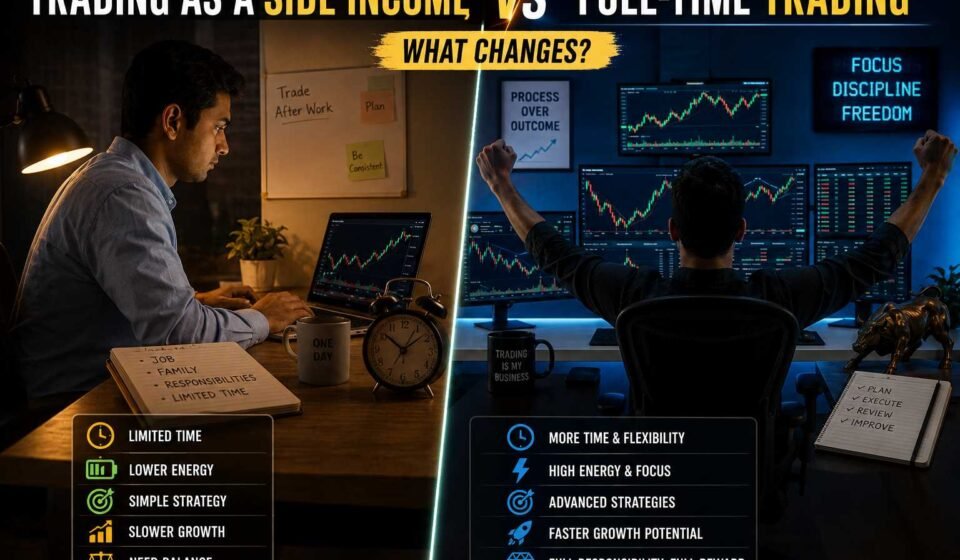

Going full-time does not change your strategy. It changes the pressure sitting behind every trade you take, and that pressure changes your decisions in ways most traders do not see coming until they are already three months in.
This post is about what actually shifts when trading stops being a side activity and becomes the thing that pays the rent. Not the obvious stuff like screen time. The psychological mechanics underneath.
The math changes, but the pressure changes more
Side income trading has a safety net. If this month is flat or down, the salary still lands on the 1st. That safety net does something specific to your decision-making: it lets you take a loss without your brain treating it as an emergency.
Full-time trading removes that net. Now every red month is not just a red month, it is a real question about whether rent gets paid, whether the family budget holds, whether this was the right decision to quit the job. That question sits in the back of your mind on every single trade, even the ones that have nothing to do with it. It shows up as:
- Cutting winners early because the money “feels real” the moment it is unrealized profit.
- Holding losers longer because closing them makes the monthly shortfall official.
- Taking trades on marginal setups near the end of the month to “make the number.”
- Checking the account balance far more often than the strategy requires.
None of these come from bad strategy. They come from the strategy being executed by someone whose bills are now attached to the outcome.
Why full-time traders often perform worse than part-time, at first
This surprises people, but it is common. A trader who was quietly profitable as a side activity often gets worse in their first 6-12 months of trading full time.
The reason is not more screen time causing more mistakes, although that is part of it. The bigger reason is that the psychological cost of a loss goes up sharply the moment income depends on the outcome. Losses hurt roughly twice as much as equivalent gains feel good, and that gap widens further when the loss threatens something as basic as monthly income. A ₹15,000 loss that used to be an annoying Tuesday becomes, mentally, a threat to the month’s grocery budget. The same loss, the same trade, a completely different weight.
“I need this month to work. I can’t afford another flat month like last time.”
That thought does not sound like fear. It sounds like motivation. It is actually the thing that pushes size up and rules down.
What genuinely changes, in order of impact
1. Position sizing pressure
Part-time traders can afford to be patient with small size because the outcome does not determine next month’s expenses. Full-time traders feel pressure to size up to “make it worth doing full time,” which is exactly backwards. The math of trading does not care whether you need the money. Sizing based on need instead of edge is one of the fastest ways to blow up a previously working system.
2. Number of decisions per day
Side income trading usually means a handful of trades reviewed before or after work hours. Full-time trading opens the door to watching every candle, every tick, all session. More decisions means more chances to override your own rules, and decision quality degrades as the number of decisions in a day goes up. This is covered in detail in Decision Fatigue: Why Your Worst Trades Happen Late in the Day.
3. Identity gets attached to daily results
A side income trader who has a bad week is still, first and foremost, whatever their day job says they are. A full-time trader who has a bad week has, in their own head, just had a bad week at being who they are. That is a heavier psychological load, and it leaks into next week’s trades as extra caution or extra recklessness, depending on the person.
4. Loneliness and lack of structure
A job provides a schedule, colleagues, and external accountability, even a boring one. Full-time trading removes all three unless you build replacements deliberately. Traders who go full-time without any external structure often report more emotional volatility in their trading, not less, because there is nothing outside the P&L to anchor the day.
What should be true before you go full-time
There is no perfect readiness checklist, but three things matter more than the rest.
- At least 12 months of tracked, consistent results as a side activity, ideally covering a full market cycle, not just one strong trending stretch.
- A cash buffer separate from your trading capital, covering 6-12 months of expenses, so a flat quarter does not become an existential threat that distorts your decisions.
- A daily structure already tested, not one you plan to figure out once you quit. If you do not already know what time you stop trading each day, going full-time will not teach you, it will just remove the guardrail that used to force the stop.
None of these guarantee success. They remove the specific pressure that turns a working part-time system into a struggling full-time one.
A middle path that most traders skip
The choice does not have to be binary. A structured transition period, where you reduce job hours to part-time or negotiate a sabbatical while trading at full-time hours in parallel, gives you a real test of the psychological load without removing the safety net completely.
During this period, three things become visible that a pure side-income setup never reveals. First, whether you can actually sustain full trading hours day after day without your energy or attention degrading by week three. Second, whether your rules hold up when trading is the main activity of your day rather than squeezed in around a job. Third, whether the loneliness of trading alone, without office colleagues or a boss checking in, affects your mood and decision-making in ways you did not expect.
Traders who skip this middle step and jump straight from a job to full-time trading often discover these three things the hard way, during months when the discovery itself is expensive. A three to six month trial period, even an imperfect one, surfaces most of the same lessons at a much lower cost.
What changes about your relationship with the market itself
There is one more shift worth naming directly, because it rarely gets discussed. As a side income, the market is something you visit. As a full-time activity, the market becomes something you live inside for six hours a day, five days a week. That shift changes how much identity gets built around daily outcomes, which connects directly to the pressure described above but deserves its own attention.
Traders who go full-time without addressing this directly often find that weekends and holidays start to feel strange, almost uncomfortable, because the primary structure of their day has disappeared. Building deliberate structure outside the market, exercise, family time, a hobby unrelated to trading, is not a nice-to-have for full-time traders. It is part of what keeps the market from becoming the only source of daily meaning, which is an unhealthy load for any single activity to carry.
Frequently asked questions
Is full-time trading always worse for psychology than part-time?
Not always, but it is always different, and usually harder at the start. The core issue is that income dependency raises the emotional cost of every loss. Traders who prepare for that specific shift, rather than just the schedule shift, tend to adjust faster.
How long should I trade part-time before going full-time?
There is no universal number, but a full year of tracked, consistent results across different market conditions is a reasonable minimum. Anything shorter has not tested you through enough variety of conditions to know if the edge is real.
Does having a financial cushion actually change trading behaviour?
Yes, measurably. A cushion changes what a losing month means psychologically. Without it, every loss carries the extra weight of a real financial threat, which pushes toward oversized, urgent decisions. With it, a loss stays a loss.
Should I quit my job the day I go full-time, or transition gradually?
Gradual is almost always better. Reducing job hours or working notice period while trading full-time hours in parallel lets you test the daily structure and the psychological load before removing the safety net completely.
What is the biggest mistake full-time traders make in the first few months?
Increasing position size to justify the decision to go full-time. The strategy that worked part-time at a certain size is the same strategy at the same size. Need for income is not an input the market responds to.
The real point
Full-time trading does not require a better strategy than part-time trading. It requires a stronger buffer between your bills and your buy button, and a level head that is not confusing income pressure with signal.
The market does not reward better predictions. It rewards better decisions, made the same way whether or not the rent depends on it.
Paisa zaroori hai, lekin pressure mein liya gaya trade kabhi safe nahi hota.
Related reading:
- Trading Psychology: The Complete Guide for Indian Traders
- Trading With Family Money: The Extra Pressure No One Talks About
- Building a Daily Practice: Meditation, Movement and Markets
- How to Spend Your Time Wisely as a Trader (Especially on Weekends)
Want to break this loop properly? I run a free live session twice a week for traders with two or more years of experience who know the setups but still cannot execute under pressure. Register for the next free session here.
I am Samir Dash, founder of Mindful Trading Hub. I work with experienced traders on live market decision-making. More about my story here.