

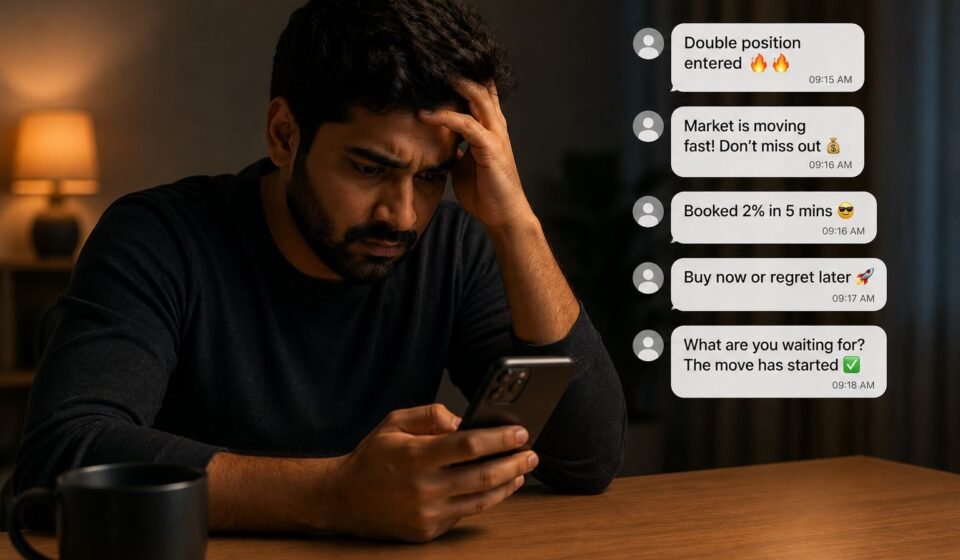

A trading WhatsApp group is not a research tool. It is a social space that happens to talk about the market. Once you understand that distinction, a lot of your own trading behaviour inside these groups starts to make more sense, and some of it starts to look like a problem worth fixing.
What actually happens inside a trading group
Most trading WhatsApp groups run the same way. Someone posts a call, often with a screenshot and a target. Others react with fire emojis or a quick “in.” A few post their entry price, publicly, within seconds. If the call works, the group celebrates. If it does not, the thread usually goes quiet, and the next call arrives soon after.
None of that is inherently dishonest. But none of it is analysis either. It is a live audience watching each other make decisions in real time, and audiences change behaviour, even when nobody intends for them to.
Why watching others trade changes your own trades
Humans are wired to look at what other people are doing when a decision feels uncertain, especially when time is short. This is not a trading-specific flaw. It is how people decide which restaurant to enter on an unfamiliar street, and it is how they decide whether to enter Bank Nifty at 9:20 in the morning.
Inside a WhatsApp group, this shows up in a specific sequence:
- A call gets posted with confident language and a screenshot.
- Two or three members reply “in” within a minute.
- Seeing others already in the trade reduces your own need to verify the setup yourself.
- You enter, often without checking whether the setup matches your own rules at all.
- If it goes wrong, the loss feels less personal, because “everyone was in it,” which quietly makes it easier to do the same thing again next time.
That last point is the most damaging part. Group losses feel diluted, which removes the natural discomfort that would normally make you tighten your rules after a bad trade.
The specific pressures a trading group creates
Fear of missing the call
When ten people in a group are already in a trade and it is moving in their favour, staying out starts to feel like the wrong decision, even if your own analysis says otherwise. This is chasing a breakout after it already moved, but with a social layer added on top that makes the urge stronger.
Fear of looking slow or unsure
Posting “let me check my chart first” while others are already posting entry confirmations can feel awkward, even in an anonymous group. Nobody wants to be the one person still thinking while everyone else has acted. That discomfort pushes people to act faster than their own process usually allows.
Borrowed confidence
A call posted by someone the group treats as skilled carries a kind of confidence that did not come from your own analysis. You did not build that confidence through your own homework, which means you also cannot maintain it when the trade goes against you. This is why group-sourced trades are often exited badly, either too early on the first red candle or too late out of stubborn hope.
Why this is worse than following a single tipster
A single source of tips is easy to be suspicious of. A group of 200 people reacting in real time feels like evidence, even though the group is really just 200 individuals reacting to the same original call and to each other, not 200 independent opinions. This is sometimes called an information cascade. Once a few people move, everyone else’s reaction gets read as confirmation, when in fact it is mostly an echo of the same first signal.
“If this many people are in it, there must be something to it.”
That thought feels like logic. It is actually just a headcount, and a headcount is not analysis.
What actually helps
Read calls, do not react to calls
Treat every group call as a chart idea to check yourself later, not as an entry signal to act on immediately. If the setup still looks valid against your own rules after you have checked it independently, take it as your own trade, sized the way you size your own trades. If it does not hold up, let it go, even if the group is currently celebrating it.
Mute during market hours if needed
If you notice yourself checking the group more than your own charts during the trading session, mute it during market hours and read it afterward, when there is no live pressure attached to what you read. The information will still be there. The urgency will not follow you into it.
Track group-sourced trades separately
Keep a simple tag in your trading journal for any trade that originated from a group call rather than your own scan. After a month, look at the win rate and average R multiple for that tag versus your own setups. Most traders are surprised by how much worse the group-sourced trades perform, because the feeling of a group trade winning is more memorable than the quieter, more frequent losses.
Decide your group’s actual purpose in advance
A trading group can be genuinely useful for market context, macro news, or discussing setups after the fact. It becomes a problem specifically when it becomes a live source of entry signals you did not generate yourself. Decide which one your groups are actually for, and be honest with yourself if they have quietly become the second kind.
Where this connects to copy trading
A WhatsApp group call and a paid tipster’s call are really the same behaviour wearing different clothes. Both replace your own analysis with someone else’s confidence. The deeper mechanics of why this fails so consistently, and what a better relationship with outside opinions looks like, are covered in copy trading and tips: why following others fails.
What a healthy relationship with a trading group looks like
It is worth picturing the alternative clearly, since most of this post has focused on what goes wrong. A healthy use of a trading group looks fairly quiet from the outside.
You read the group after market hours or during breaks, not continuously through the session. You treat calls as leads for your own watchlist, not as instructions. You occasionally share your own analysis, which tends to shift your relationship with the group from consumer to contributor, and contributors tend to think more critically about what gets posted, including their own posts. You do not feel a pull to explain yourself if you skip a call the group is excited about, because your own criteria, not the group’s mood, are what you are answerable to.
A simple test for where you currently stand: imagine the group went silent for a week, no calls, no reactions, nothing. Would your trading decisions change? If the honest answer is yes, meaningfully, that is worth sitting with. A trading group that has become a genuine dependency for decision-making is different from one that is simply a pleasant source of market chatter, and only one of those two is actually a problem.
Frequently asked questions
Is it wrong to be in a trading WhatsApp group?
No. The group itself is neutral. The problem is using it as a live entry signal instead of a source of ideas you verify independently before acting on them.
Why do I trust a group call more than my own analysis?
Because seeing other people already committed to a decision reduces your own felt need to verify it. This is a normal social pattern, not a sign of weak analysis skills on your part.
How do I know if a call is worth checking myself?
If it matches the instruments and setups you already trade, it is worth checking against your own rules. If it is outside your usual instruments or timeframe, that alone is a signal to skip it, regardless of how confident the group sounds.
Should I leave trading groups altogether?
Not necessarily. Many traders get real value from market discussion and shared context. The fix is usually in how you use the group, not whether you are in one.
Why do group losses feel less painful than my own mistakes?
Because the loss feels shared, even though the money leaving your account is not shared at all. That diluted feeling removes the discomfort that would normally push you to tighten your process after a bad trade.
The real point
A WhatsApp group can be a useful window into what other traders are watching. It cannot replace your own checklist, and the moment it starts to, your losses stop teaching you anything, because they no longer feel entirely yours.
The market does not reward better predictions. It rewards better decisions.
Group ki entry alag hai, apna trade apna hona chahiye.
Related reading:
- How Long It Actually Takes to Become a Consistently Profitable Trader
- Inner Alignment: Why Your Trades Reflect What Is Actually Going On Inside You
- You Know the Strategy. Why Can You Not Follow It?
Want to break this loop properly? I run a free live session twice a week for traders with two or more years of experience who know the setups but still cannot execute under pressure. Register for the next free session here.
I am Samir Dash, founder of Mindful Trading Hub. I work with experienced traders on live market decision-making. More about my story here.