

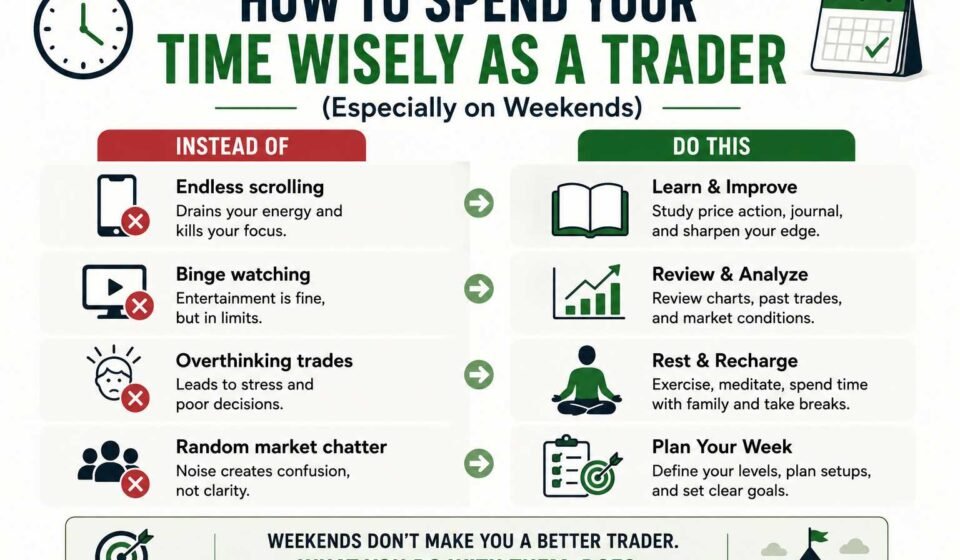

Ask a trader what they did last weekend and you tend to get one of two answers. Either “nothing, I switched off completely,” or “I was going through charts most of Saturday.” Both answers sound reasonable. Neither one is actually a strategy. It is just whatever happened by default, because nobody sat down and decided how the hours outside market timing should actually be spent.
That gap matters more than it looks. The market only takes up a few hours a day. What you do with the rest of your time, especially the two full days when the market is closed, quietly shapes how you show up on Monday morning. This post is about building an actual answer to that question, not a rigid schedule, but a real set of priorities for your time as a trader.
Why this is a decision-making problem, not a lifestyle problem
It is tempting to file “how should I spend my weekends” under general life advice, unrelated to actual trading performance. That is a mistake. Decision-making under pressure, the thing that actually determines whether you follow your own plan, is not something you switch on fresh every trading day. It is built or worn down by what happens in the hours before the market opens, including the two days before Monday.
A trader who spends the weekend either completely checked out or completely absorbed in charts arrives at Monday in roughly the same place: reactive, not prepared. The switched-off trader has lost touch with what the market did and walks in cold. The chart-obsessed trader has spent thirty hours reinforcing the same anxious relationship with the screen that caused problems during the week. Neither version arrives more capable of calm execution than the other.
The four things worth your time as a trader
Most traders’ time, across a full week, actually needs to go toward four different things. Weekdays outside market hours and weekends both draw from the same four categories, just in different proportions.
1. Actual rest, not passive screen time
There is a difference between resting and simply not trading. Scrolling financial Twitter, watching market recap videos, or half-reading news for three hours on a Saturday is not rest. It keeps the same part of your brain activated that trading does, just without the stakes. Real rest means your attention is somewhere else entirely: with family, outdoors, doing something physical, something that has nothing to do with price movement. This site has covered how much screen time is actually too much, and weekends are exactly where that boundary gets tested the most, since there is no market open to force a natural stopping point.
Traders who never build in real rest do not become more prepared, they become more brittle. Fatigue does not announce itself. It shows up quietly as a shorter fuse after a loss, a slightly faster trigger finger on a revenge trade, a stop that gets moved because you are too tired to sit with the discomfort of watching it get hit.
2. A light, structured review, not a chart-staring marathon
This is the one place where some deliberate market-related time is genuinely useful, and the key word is deliberate. A weekly review, looking at the pattern across five days rather than any single day, catches things a daily review cannot. If you moved your stop once on Tuesday and once on Thursday, neither day alone looks like a pattern. Looking at the week together, it might be obvious both happened on trades taken after 2pm, when fatigue had already set in.
This site has a dedicated post on exactly what that weekly review should contain, and it is worth reading in full if you are not already doing one. The short version: it should take thirty to forty-five minutes, not four hours, and it should produce one specific change to make, not a list of five good intentions that never survive Monday morning.
The mistake to avoid is letting “I am doing my weekly review” become an excuse for an entire Saturday spent in front of charts. A review has a clear start and end point. Open-ended chart watching does not.
3. Learning that compounds, not information that just fills time
There is a real difference between learning and consuming. Watching another hour of generic market commentary is consuming. Working through one specific weakness, actually studying the setups you keep mismanaging, reading one chapter of a book that addresses a real gap, practicing position sizing math until it is automatic, that is learning. It takes less time and produces more change.
Weekends are a natural place for this kind of focused learning precisely because there is no live position pulling at your attention. Use that. Pick one specific skill or weakness each week rather than trying to absorb everything the market produced. A trader who spends ninety focused minutes fixing one real gap gets more out of a weekend than one who spends six hours passively watching market content.
4. Life outside the market, protected on purpose
This is the category that gets sacrificed first and talked about least. Family, physical health, friendships, hobbies that have nothing to do with trading. It is easy to treat this time as whatever is left over after market-related tasks, rather than something that is actually protected on the calendar.
This matters for a reason beyond quality of life. A trader whose entire identity and time budget revolves around the market is far more likely to take a loss personally, because there is nothing else the loss can be measured against. A trader with a full life outside trading has more perspective when a bad week happens, not less commitment, more perspective. That perspective is exactly what keeps a string of losses from turning into desperate, size-up-to-recover decisions.
What a realistic weekend actually looks like
Not a rigid hour-by-hour schedule, since that rarely survives contact with an actual weekend, but a rough shape worth aiming for:
- One focused block, thirty to forty-five minutes, for the weekly review described above.
- One focused block, an hour or so, for deliberate learning on a single specific gap.
- The rest, genuinely the rest, protected for family, physical activity, and things that have nothing to do with the market.
That is perhaps two hours of market-related time across an entire weekend, done with real focus, against thirty-plus hours of everything else. Compare that to the more common pattern, either zero structured hours and total avoidance, or ten-plus unstructured hours of anxious chart-watching that produces no actual insight. Two focused hours beats both.
What to watch for during the week too
The same principle applies outside weekends, just compressed. The hours after the market closes on a weekday are where a lot of traders lose ground without noticing, checking positions repeatedly for no functional reason, reading news that will not change anything actionable, replaying a loss over and over instead of doing the actual review once and moving on. If you find yourself opening the trading app for the fifth time after the market has already closed, that is rarely information gathering. It is usually anxiety looking for somewhere to go.
The same four-category thinking applies here in miniature: was that screen time actual review, or just anxious repetition. Was it learning, or just consumption. The honest answer is usually easy to spot once you ask the question directly.
Frequently asked questions
Should I completely avoid the market on weekends?
No, and total avoidance is not actually the goal. A short, structured weekly review is genuinely useful and something most traders skip entirely. The goal is a small, deliberate amount of market-related time, not zero, and definitely not unlimited.
How much time should a weekly review actually take?
Thirty to forty-five minutes is enough for most traders. If it is regularly taking longer than an hour, it has likely turned into unstructured chart watching rather than a focused review.
Is watching market news and commentary on weekends a waste of time?
Not entirely, but it is easy to overestimate how useful it actually is. Passive consumption of general commentary rarely changes a specific decision you will make. Time spent on one focused, specific gap in your own trading tends to produce far more improvement than hours of general market content.
What if my weekends are already fully booked with family and other responsibilities?
That is not a problem to fix, it is often already the healthiest version of this. The weekly review can happen in thirty focused minutes on a weekday evening instead. The point was never that weekends specifically must be used a certain way, it is that market-related time should be deliberate rather than accidental, wherever it happens to sit in your week.
How does this actually affect my trading performance?
Indirectly but genuinely. Rested, deliberate use of time builds the same discipline that shows up as calmer decision-making when a trade is live. Traders who arrive at Monday either burned out from chart-watching or completely unprepared from total avoidance tend to make worse decisions in the first hour of the week than traders who did a short, focused review and otherwise actually rested.
The short version
Time outside market hours is not neutral. It either builds the discipline that shows up when a trade is live, or it quietly wears it down. A short, deliberate weekly review, some focused learning on one real gap, and genuinely protected time for everything else outperforms both total avoidance and anxious, unstructured chart watching. The market only asks for a few hours of your day. What you do with the rest is still part of how you trade.
Samay ka sahi upyog hi asli discipline hai, sirf trading ke ghanton mein nahi.
Related reading:
- Weekend Habits of Consistently Profitable Traders
- Screen Time and Trading: How Much Is Too Much
- The ACE Framework: Aware, Control, Execute Explained
Want to learn this from the source? I run a free live session twice a week for traders with two or more years of experience who know the setups but still cannot execute under pressure. Register for the next free session here.
I am Samir Dash, founder of Mindful Trading Hub. I work with experienced traders on live market decision-making. More about my story here.